India Win Asian Games Wrestling Medal in 97kg Category After 60 Years
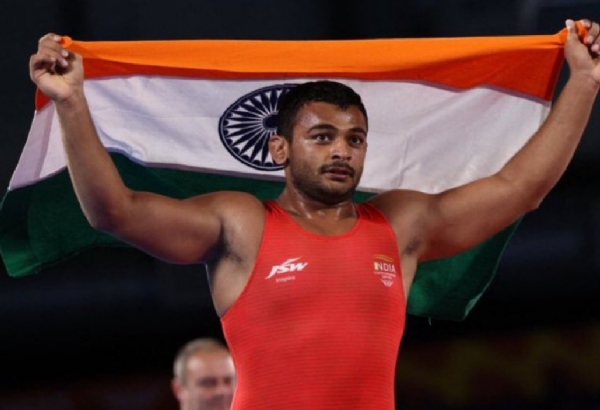
Aichi-Nagoya, October 3 (HS): India’s experienced wrestler Deepak Punia created history on Saturday by winning the bronze medal in the men’s 97kg freestyle wrestling category at the 2026 Asian Games. Punia defeated Mongolia’s Gankhuyag Ganbaatar 2-1 in the bronze-medal bout. With the victory, he secured India’s first Asian Games medal in this weight category in 60 years.
Punia took a 2-0 lead in the opening period. The Mongolian wrestler managed to fight back by securing a point in the second period, but Punia displayed excellent defensive wrestling in the closing stages to preserve his narrow advantage and win the bout 2-1.
During the final stages of the contest, the two wrestlers remained locked in a closely contested battle for an extended period. The referee issued warnings over inactivity, and Punia conceded a passivity point. Gankhuyag then made several attacking attempts, but Punia successfully defended himself and held on to his lead during the final 30 seconds to secure the bronze medal.
India’s 97kg Medal After 60 Years
Punia’s bronze is India’s first Asian Games medal in the 97kg freestyle category in 60 years. India had previously won medals in this weight category at the 1962 and 1966 Asian Games.
In 1962, Maruti Mane won the gold medal and Ganpat Andalkar claimed silver. At the 1966 Asian Games, Vishwanath Singh won silver and Bhim Singh secured bronze. Punia’s bronze has now taken India’s medal tally in the 97kg category to five.
Back-to-Back Asian Games Medals
This is Deepak Punia’s second consecutive Asian Games medal. At the Hangzhou Asian Games in 2023, he won the silver medal in the 86kg freestyle category. This time, competing in the 97kg category, he added a bronze medal to his record.
Gankhuyag Ganbaatar had won the bronze medal in the 97kg category at the Hangzhou Asian Games. This time, however, he was defeated by Punia in the bronze-medal bout.
Wrestling Journey Began at the Age of Five
Deepak Punia was born on May 19, 1999, in Chhara village in Haryana’s Jhajjar district. He began wrestling at the age of five at the traditional mud wrestling arena in his village. His early training was provided by former wrestler Virendra Singh. His father, Subhash Punia, was also a former wrestler and worked as a dairy farmer.
Having grown up in a family associated with wrestling, Punia participated in local dangals and gradually developed his skills while also contributing to the family. His talent was recognised after he performed well at the school level, following which he got an opportunity to train at Delhi’s prestigious Chhatrasal Stadium.
His journey from a traditional mud akhara to the international wrestling mat was far from easy, but through hard work and adaptability, Punia established himself at the international level.
Strong Comeback After Olympic Disappointment
At the Tokyo 2020 Olympics, held in 2021, Punia narrowly missed out on a medal and finished fifth after losing the bronze-medal bout. He subsequently made a strong comeback. At the Hangzhou Asian Games, he reached the final of the 86kg category and won the silver medal.
Punia also won gold at the 2022 Commonwealth Games. In addition, he won silver medals at the 2021, 2022 and 2025 Senior Asian Wrestling Championships and bronze medals at the 2019 and 2020 Senior Asian Wrestling Championships. He also won silver at the 2019 World Wrestling Championships in the 86kg category.
Punia currently trains at Chhatrasal Stadium in Delhi. With his historic bronze in the 97kg category, he has also achieved the distinction of winning medals at two consecutive editions of the Asian Games.
---------------
Hindusthan Samachar / Jun Sarkar
18 Aug 2026
Cincinnati Open: Williams Sisters Fall in First Round, Kostyuk-Stearns Duo Edges Them Out in Super Tiebreak
18 Aug 2026