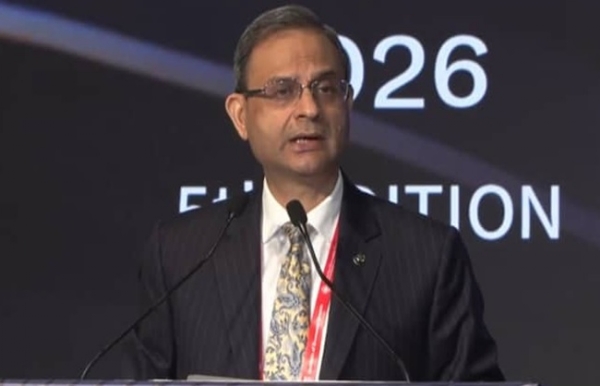
New Delhi, 03 October (H.S.): Reserve Bank of India (RBI) Governor Sanjay Malhotra said on Saturday that India has adopted a cautious approach towards cryptocurrencies, while promoting technologies associated with crypto assets, including distributed ledger technology and tokenisation.
The RBI Governor made the remarks while addressing the fifth Kautilya Economic Conclave in New Delhi. Malhotra said India supports innovation in technologies associated with crypto assets. These include distributed ledger technology (DLT), or decentralised digital ledger technology, as well as tokenisation. However, he said the country remains cautious about cryptocurrencies because of concerns relating to monetary sovereignty, monetary policy and capital flows.
Addressing the Kautilya Economic Conclave, Sanjay Malhotra said, “Our approach has been to promote the underlying technologies. We are using some of these technologies within the central bank and externally under public-private partnerships (PPPs). But as far as crypto is concerned, we have adopted a cautious approach.”
Referring to concerns associated with cryptocurrencies, he said these relate to the “uniformity of money”, or the fungibility and uniform value of money, as well as their potential impact on monetary policy. Such effects could be particularly significant for emerging economies where restrictions are imposed on capital flows.
The RBI Governor said that a more important challenge is cross-border payments, for which various alternatives, including central bank digital currencies (CBDCs), could be considered. He also spoke about rising public debt globally and increasing bond yields, saying that movements in yields fundamentally depend on demand and supply.
He said spending by both governments and the private sector is increasing, including expenditure driven by artificial intelligence (AI). Malhotra said, “Money is limited, while spending has increased. Spending by governments as well as private companies has risen, with AI playing a role. This is contributing to higher bond yields and an increase in debt.”
The RBI Governor said the central bank’s monetary policy remains primarily focused on domestic growth and inflation conditions. However, he noted that global interest rates also have an impact on India, including their effect on real interest rates in the country.
It may be noted that distributed ledger technology is a digital system in which transactions and other records are maintained in a decentralised manner rather than being stored at a single location. The records are shared across multiple computers or nodes within a network. Tokenisation, meanwhile, is the process of converting ownership of a real-world asset or sensitive information, such as credit or debit card details, into a secure digital representation known as a token.
---------------
Hindusthan Samachar / Jun Sarkar