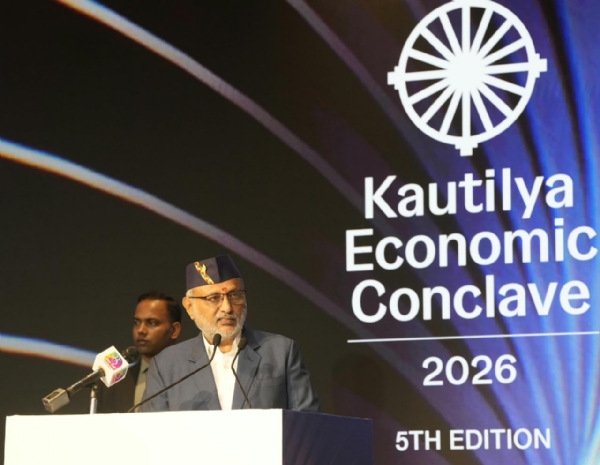
New Delhi, 03 October (H.S.): Vice-President C. P. Radhakrishnan on Saturday said that amid rapidly changing circumstances, it is essential to combine decision-making with broad-based consensus, and that in a democracy, debate and discussion should ultimately lead to decisions that command wide acceptance.
Addressing the inaugural session of the fifth Kautilya Economic Conclave, Radhakrishnan said that amid changing global circumstances, India needs economic policies that are resilient, inclusive and responsive to evolving conditions. He said that free and transparent debate strengthens democracy, but rights and duties must go hand in hand.
The Chairman of the Rajya Sabha said India has demonstrated that democracy and development can advance together. He said that within a democratic framework, consensus-building alongside economic growth and inclusive progress has made economic reforms more sustainable. He described this as an important foundation for achieving the goal of a developed India by 2047.
Radhakrishnan said economic resilience cannot be separated from social resilience. He highlighted the role of Jan Dhan-Aadhaar-Mobile (JAM), Direct Benefit Transfer and the Goods and Services Tax (GST) in strengthening financial inclusion, transparency and the formalisation of the economy.
He said that more than 590 million Jan Dhan accounts had been opened by August, while GST registrations had increased from around 6.65 million in 2017 to 16.5 million in May. He said these initiatives are helping bring people into the formal economy while strengthening transparency and financial inclusion.
The Vice-President said inclusion does not merely mean bringing people into the formal economy, but also enabling them to create value, earn incomes and become entrepreneurs. He referred to more than 100 million rural women associated with around 9.2 million self-help groups and more than 34.6 million ‘Lakhpati Didis’. He said the increasing participation of women in education and the economy reflects a shift in India from women’s empowerment towards women-led development.
Radhakrishnan said resilience is not built only in large business institutions and financial markets, but is also strengthened when a woman in a village has a bank account, receives government benefits directly, becomes part of the formal economy and transforms her self-help group into an enterprise.
He said more than 250 million Indians have been lifted out of extreme poverty and described this as a historic achievement.
He said every state, district and village must be made an equal partner in the country’s development journey. He stressed the need to understand ground realities while framing policies and to ensure that they remain flexible and responsive to changing circumstances.
The Vice-President also underlined the importance of research and institutional collaboration and welcomed cooperation among the University of Delhi, the Delhi School of Economics, the London School of Economics and the Institute of Economic Growth. He said such collaborations can strengthen research, education, innovation and entrepreneurship.
He said India’s resilience will come not from resisting change, but from embracing it with confidence, inclusion and a spirit of collective effort.
The fifth Kautilya Economic Conclave was organised on the theme ‘Resilience in an Era of Change’. N. K. Singh, Chairman of the Institute of Economic Growth, Dr Michael Debabrata Patra, Chairman of the Board of Governors, and other dignitaries were present on the occasion.
---------------
Hindusthan Samachar / Jun Sarkar
18 Aug 2026