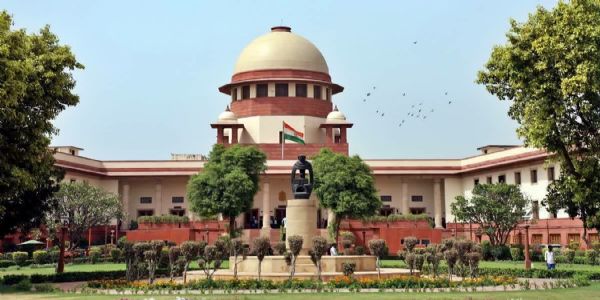
New Delhi, 29 October (H.S.): The Supreme Court has asked the Centre how it plans to ensure an adequate supply of ethanol if vehicles capable of running on 100 per cent ethanol are permitted. A Bench headed by Justice M.M. Sundresh heard the matter on Thursday and, after hearing both sides, adjourned the proceedings until next month.
The question follows an October 26 notification issued by the Ministry of Road Transport and Highways amending the Central Motor Vehicles Rules, 1989, to facilitate flex-fuel vehicles capable of running on ethanol blends of up to E100. E100 refers to fuel consisting almost entirely of ethanol, and the regulatory approval applies to vehicles specifically designed and certified to use such high-ethanol blends.
On October 27, Union Minister for Petroleum and Natural Gas Hardeep Singh Puri said the Centre had no immediate plans to increase the proportion of ethanol blended with petrol beyond the existing 20 per cent. His statement came shortly after the notification permitting E100-compatible flex-fuel vehicles.
The Supreme Court raised the issue while hearing petitions relating to ethanol allocations for the 2025-26 ethanol supply year. Referring to recent media reports about the approval of vehicles capable of running entirely on ethanol, the Bench said it wanted to understand, from an academic perspective, how the fuel would be supplied if such vehicles were permitted.
The court also emphasised the importance of empowering farmers in the context of the ethanol programme.
Attorney General R. Venkataramani told the Bench that implementing such a system would require extensive changes to existing arrangements. He assured the court that the interests and concerns of farmers would be discussed in greater detail during the next hearing.
The dispute originated from an order of the Karnataka High Court directing oil marketing companies to increase the allocation of ethanol to a particular ethanol producer. Challenging the order, an oil company approached the Supreme Court, arguing that such directions could undermine the stability of the national E20 policy, which provides for blending 20 per cent ethanol with petrol.
On June 30, the Supreme Court ordered the parties to maintain the status quo regarding the Karnataka High Court’s direction to increase ethanol allocation for the 2025-26 supply year.
The latest proceedings bring the questions of ethanol availability, supply infrastructure, allocation policy and farmers’ interests into focus as the government expands the regulatory framework for flex-fuel vehicles.
---------------
Hindusthan Samachar / Jun Sarkar
18 Aug 2026