New Delhi, 29 October (H.S.): Four out of five farmers managing paddy straw in Haryana are willing to continue adopting alternatives to stubble burning in 2026. However, only 7 per cent of farmers who get their straw baled receive payments from buyers, while around 62 per cent are compelled to give it away free of charge. Another 31 per cent have to spend approximately Rs. 1,000 per acre to get their fields cleared.
These findings are part of a new study by the Council on Energy, Environment and Water (CEEW), which surveyed 1,588 farmers across 144 villages in 12 districts of Haryana between January and March 2026. The findings were released at a discussion held in New Delhi on Thursday. A separate study examining the use of satellite imagery to monitor stubble-burning incidents in Punjab was also released at the event.
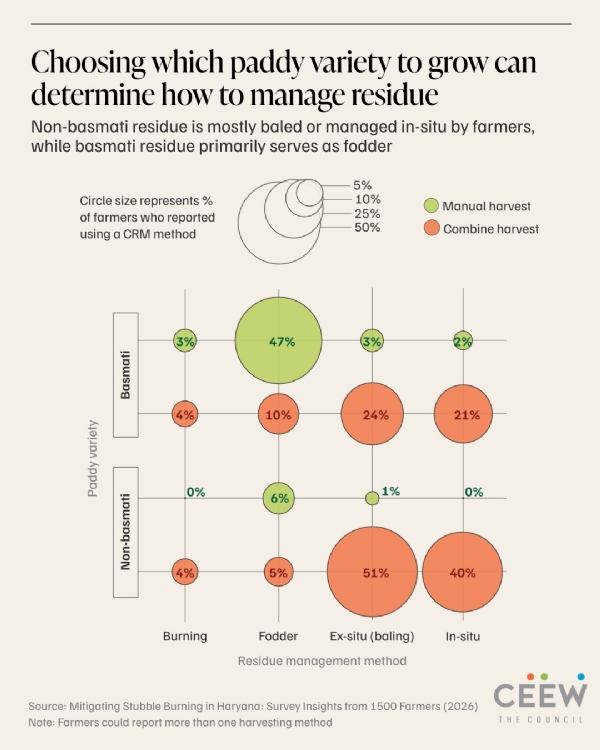
According to the Haryana study, farmers primarily use three methods to manage paddy straw. Around 39 per cent use it as animal fodder, 38 per cent get it baled, and 32 per cent incorporate crop residue into the soil using machinery such as Super Seeders. Some farmers employ more than one method.
The survey found that 80 per cent of farmers who bale paddy straw or use it as fodder intended to continue these practices in 2026. However, 6 per cent of respondents admitted to burning paddy straw, while 26 per cent reported that stubble burning occurred in their villages.
The study also found that approximately 80 per cent of farmers in Haryana were aware of a government scheme offering an incentive of Rs. 1,200 per acre for avoiding stubble burning. Despite this awareness, only 42 per cent had applied under the scheme. Of those who applied, only 57 per cent had received the payment.
Kurunji Kemanth, Programme Lead at CEEW and co-author of the study, said farmers’ willingness to adopt alternatives to stubble burning was encouraging, but financial incentives were essential to translate that intention into action. Making paddy straw a source of income for farmers, she said, would be crucial to establishing a sustainable agricultural system without stubble burning.
She noted that 87 per cent of farmers who get paddy straw baled rely on aggregators to facilitate the process. Nevertheless, only 7 per cent receive payments from buyers. Around 62 per cent give their straw away free of charge, while 31 per cent pay approximately Rs. 1,000 per acre to have their fields cleared.
The use of Super Seeders also increases farmers’ costs. Many farmers operate the machinery two or more times to ensure that fields are sufficiently cleared and levelled. This can push the cost to between Rs. 4,000 and Rs. 4,500 per acre.
CEEW’s second study assessed stubble-burning incidents across an area of approximately 1,600 square kilometres in Punjab’s Sangrur and Patiala districts. It used freely available Sentinel-2 satellite imagery alongside commercial PlanetScope images.
An analysis combining imagery from both sources across five villages identified between two and five times as many burnt fields as an assessment based solely on Sentinel-2 images. The combined approach achieved an overall accuracy of approximately 75 per cent.
Researchers clarified, however, that this method was not intended to replace the official count of stubble-burning incidents. Instead, it could complement existing monitoring systems and help improve their effectiveness.
Mohammad Rafiuddin, Programme Lead at CEEW and co-author of the study, said thousands of crores of rupees had been spent on supporting farmers in avoiding stubble burning. States therefore needed to understand where this assistance was working effectively and which villages required greater access to machinery and industries capable of purchasing paddy straw.
The study recommended that the Commission for Air Quality Management (CAQM) consider tracking not only the number of stubble-burning incidents but also the extent of the area affected and burnt. It suggested that protocols already tested in collaboration with the Indian Space Research Organisation (ISRO) could be used for this purpose.
The researchers also emphasised the need to strengthen India’s domestic satellite-monitoring capabilities to improve the assessment and monitoring of stubble burning.
---------------
Hindusthan Samachar / Jun Sarkar

18 Aug 2026