India Committed to Building a Safe, Stable and Peaceful Indo-Pacific with Its Partners
New Delhi, October 29 (HS): Defence Minister Rajnath Singh has said that India’s fight against terrorism is not merely theoretical but is grounded in decades of operational experience and successful counter-terrorism missions. He said Operation Sindoor, which dismantled terrorist infrastructure, demonstrated India’s unwavering resolve to combat terrorism and sent a clear message to the international community.
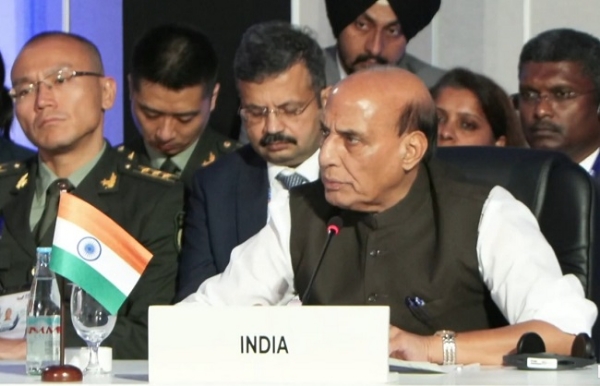
Addressing defence ministers from ASEAN member states at the 13th ASEAN Defence Ministers’ Meeting-Plus (ADMM-Plus) in Cebu, the Philippines, Singh reaffirmed India’s commitment to sharing its experience with partner nations to help build a safe, stable and peaceful Indo-Pacific region.
Participating in the meeting alongside the Indian delegation, Singh highlighted the youthful populations of India and ASEAN as their greatest strength. To harness this demographic potential, he proposed establishing a dedicated Defence Youth Bridge to strengthen people-to-people connectivity, promote digital innovation and facilitate capacity-building. Empowering young people, he said, would help shape a peaceful, stable and prosperous future for the Indo-Pacific.
Singh said the principle of Sarve Bhavantu Sukhinah—the aspiration for the well-being and happiness of all—lies at the heart of India’s defence and foreign policies. The theme of ADMM-Plus, “Advancing Our Future Together”, underscores the importance of shared responsibility, mutual trust and cooperation.
He reiterated India’s commitment to building an open, inclusive and rules-based Indo-Pacific in which ASEAN’s central role and India’s long-standing strategic partnerships remain vital. He also highlighted the Indian Navy’s decades-long contribution to safeguarding global maritime trade and critical sea lines of communication.
As a reliable security partner, India remains committed to ensuring a safe and stable Indo-Pacific, upholding freedom of navigation and respecting international maritime law, he said.
Singh also reaffirmed India’s commitment to eliminating terrorism in all its forms and strengthening collective regional security. He emphasised that India’s extensive counter-terrorism experience was not confined to theoretical knowledge acquired in classrooms but had been forged through decades of confronting complex security challenges on the ground, including those originating across its borders.
He said India’s strategies had been tested and refined through operations conducted in real-world conditions, demonstrating their effectiveness and practical value. Operation Sindoor, he added, was a decisive demonstration of this proactive, field-tested approach, during which India dismantled terrorist infrastructure and drew a clear line against state-sponsored terrorism, signalling that there would be no compromise on the issue.
The Defence Minister reiterated that India attaches particular importance to ASEAN centrality and to a safe, free, inclusive, resilient and rules-based Indo-Pacific, where peace and stability are not merely aspirations but outcomes of collective commitment.
He said India’s strategic engagement with ASEAN was long-term in nature and rested on shared interests, mutual respect and practical cooperation. Referring to the second ASEAN-India Defence Ministers’ Informal Meeting held in Kuala Lumpur in October last year, Singh recalled that both sides had reaffirmed their commitment to advancing the defence and security dimensions of the ASEAN-India Comprehensive Strategic Partnership and implementing the ASEAN-India Plan of Action for 2026-2030.
Singh further underscored the importance of youth participation in strengthening defence cooperation between India and ASEAN. He noted that the shared demographic profile and aspirations of their young populations provided a strong foundation for deeper regional partnerships.
To institutionalise people-to-people exchanges, encourage digital innovation and facilitate capacity-building in line with ADMM-Plus initiatives, he proposed establishing a dedicated Youth Bridge within the defence sector.
Empowering young people and providing them with greater opportunities to contribute to regional peace and security, he said, would be consistent with the agenda of Youth, Peace and Security. Such efforts would also be essential to building a peaceful, resilient and prosperous Indo-Pacific region.
---------------
Hindusthan Samachar / Jun Sarkar
18 Aug 2026