New Delhi, 28 October (H.S.): The Ministry of Youth Affairs and Sports, the Ministry of Education and UNESCO on Wednesday signed a landmark Memorandum of Understanding (MoU) to promote sporting values and raise awareness about doping-free sports in schools across the country.
The initiative aims to integrate values such as respect, integrity and fairness into education, sports and everyday classroom activities through the “Sport Values Toolkit in Every Classroom”. The toolkit’s video modules will be made available in 13 Indian languages to reach students across the country and help build a stronger, fairer sporting ecosystem.
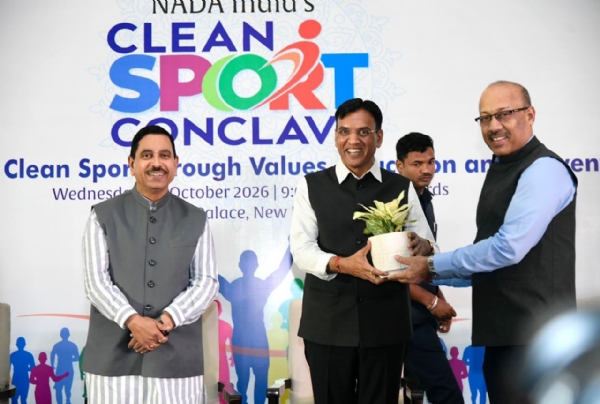
The agreement was signed during the Clean Sport Conference organised by the National Anti-Doping Agency (NADA) India. Union Minister for Youth Affairs and Sports Dr Mansukh Mandaviya and Union Education Minister Pralhad Joshi emphasised the need to integrate sports with education. The initiative is also aligned with the vision of promoting greater coordination between the two sectors, as outlined in the Khelo Bharat Policy 2025.
The conference was attended by Dr Tim Curtis, Director of UNESCO’s Regional Office for South Asia; T. K. Anil Kumar, Secretary of the Department of School Education under the Ministry of Education; Hari Ranjan Rao, Secretary of the Department of Sports under the Ministry of Youth Affairs and Sports; and Anant Kumar, Director General of NADA. International delegates who had participated in the statutory meetings of UNESCO’s anti-doping conventions on Tuesday also attended the conference. Indian javelin thrower Sachin Yadav was among the participants.
Integrity Must Accompany Sporting Excellence: Mansukh Mandaviya
Dr Mansukh Mandaviya appreciated the Ministry of Education’s cooperation, saying the partnership reflected the government’s commitment to bringing sports and education together in line with Prime Minister Narendra Modi’s vision.
“Excellence in sports and sporting integrity must go hand in hand. Talent, discipline and hard work are essential for success in sports, but integrity, fairness and credibility are equally important,” he said.
Referring to India’s fourth-place finishes at the Asian Games and the Asian Para Games, the Sports Minister said the achievements reflected the growing strength and ambition of Indian sports. However, he noted that doping remained a serious concern, requiring sustained efforts in education, prevention, testing and effective enforcement of regulations.
Mansukh Mandaviya said that during 2025-26, NADA India had conducted more than 7,000 tests and organised over 350 awareness and education sessions, reaching approximately 27,000 participants.
He further said that supplement-testing facilities at the National Forensic Sciences University in Gandhinagar and the National Institute of Pharmaceutical Education and Research in Hyderabad would help prevent inadvertent doping cases. He added that NADA’s investigative mechanisms would be strengthened in line with global practices.
The National Anti-Doping Act came into force this year, he said, adding that the government was also preparing to introduce provisions before Parliament to criminalise doping-related activities.
Agreement to Bridge the Gap Between Education and Sports: pralhad Joshi
Union Education Minister Pralhad Joshi said the agreement would help bridge the long-standing gap between education and sports. He observed that students who perform well academically often do not participate in sporting activities, highlighting the need to expand grassroots-level sporting opportunities and create better pathways for young athletes to progress.
“This agreement marks an important step towards strengthening the relationship between education and sports, a connection whose absence has long been felt. Through this initiative, we are working to ensure that sporting values become an integral part of every child’s educational experience,” he said.
Pralhad Joshi expressed satisfaction that children were now being educated about clean sports and the values associated with them. He emphasised that the principles promoted through the toolkit should extend beyond classrooms and reach every section of society.
By integrating sporting values into education, he said, the initiative could help nurture responsible citizens and foster a culture of fairness and integrity from an early age.
Toolkit to Teach Children the Importance of Playing by the Rules: UNESCO
Dr Tim Curtis, Director of UNESCO’s Regional Office for South Asia, described the agreement as a new chapter in the organisation’s partnership with India. He said the initiative had the potential to reach millions of young people and could serve as a model for other countries.
“Every child sitting in a classroom can learn what it means to play by the rules. Through this toolkit, we are embedding three fundamental values in education and sports: respect, integrity and fairness,” Curtis said.
He added that while the toolkit provided ideas and practical resources, teachers would play a crucial role in translating these values into practice. He stressed the importance of observing interactions on school playgrounds and how children treated one another in everyday situations.
“The real test of these values comes when nobody is watching, yet children still choose to play fairly. This is the kind of integrity we want to nurture in children from an early age,” he said.
Through the agreement, the government and UNESCO aim to ensure that sporting values extend beyond playing fields and become an integral part of children’s education and daily lives. The broader objective is to foster a culture of fairness, responsibility and doping-free sports across the country.
---------------
Hindusthan Samachar / Jun Sarkar
18 Aug 2026
Cincinnati Open: Williams Sisters Fall in First Round, Kostyuk-Stearns Duo Edges Them Out in Super Tiebreak
18 Aug 2026