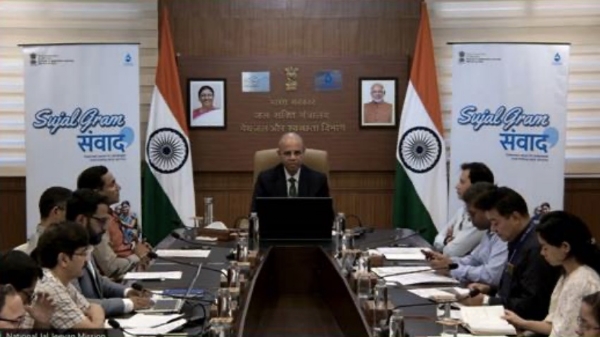
New Delhi, 28 October (H.S.): The Department of Drinking Water and Sanitation (DDWS) under the Union Ministry of Jal Shakti organised the 12th edition of ‘Sujal Gram Samvad’ on Wednesday, emphasising the role of Gram Panchayats in the operation and maintenance of rural drinking water schemes, conservation of water sources, and ensuring the long-term sustainability of these systems through user charges. Representatives of five Gram Panchayats shared their experiences and best practices during the interaction.
The session was chaired by Ashok K. K. Meena, Secretary of the Department of Drinking Water and Sanitation, and attended by Kamal Kishor Soan, Additional Secretary and Mission Director of the National Jal Jeevan Mission, along with other senior officials.
Meena stressed that Panchayats should regularly assess the performance of water supply services through service assessment and Swachh Seva assessment mechanisms. He also called for the effective utilisation of grants provided by the 16th Finance Commission and the development of systems to collect user charges to ensure the proper maintenance and long-term sustainability of water supply schemes.
The Ghalian Gram Panchayat in Kangra district of Himachal Pradesh shared its experience of transforming rural water access through the Jal Jeevan Mission. Before the mission was implemented, residents depended on borewells and water tankers. However, all six villages under the Panchayat now receive a regular water supply. Women have also been trained to test water quality.
The Itore Gram Panchayat in West Singhbhum district of Jharkhand has introduced a monthly user charge of Rs. 62 per household. District Deputy Commissioner Manish Kumar said that schools and Anganwadi centres in the area had also been connected to tap water facilities.
The Athal Gram Panchayat in Dadra and Nagar Haveli reported improvements in public health and overall quality of life following the introduction of piped water supply.
In Mizoram’s Sialhawk Gram Panchayat in Khawzawl district, each household contributes Rs. 150 per month towards the maintenance of the water supply system. The Natha New Village Gram Panchayat in Zunheboto district of Nagaland reported that all households in the village had access to tap water connections. The community has also undertaken plantation activities in the catchment area to protect local water sources.
In his concluding remarks, Soan emphasised that conserving water sources and ensuring active community participation were essential to sustaining drinking water schemes over the long term.
He urged Gram Panchayats and district administrations to prepare comprehensive action plans under Gram Panchayat Development Plans by coordinating resources available through the Viksit Bharat–Guarantee for Rozgar and Ajeevika Mission (Gramin) (VB-G RAM G), Finance Commission grants and state government schemes. These plans, he said, should prioritise water conservation, the revival of traditional water bodies and the effective operation and maintenance of rural water supply systems.
---------------
Hindusthan Samachar / Jun Sarkar
18 Aug 2026