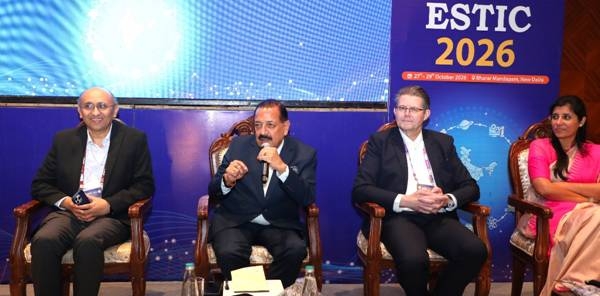
New Delhi, 27 October (H.S.): Union Minister of State (Independent Charge) for Science and Technology Dr. Jitendra Singh on Tuesday said India’s rich genetic diversity could help the country establish a significant global position in gene research, adding that other countries may increasingly look to India for its unique genetic resources in the coming years.
Addressing a session on Systems and Synthetic Biology at the Emerging Science, Technology and Innovation Conclave (ESTIC-2026), held at Bharat Mandapam in New Delhi, Singh said India’s genetic and physiological diversity offered significant opportunities for scientific research. It could help researchers better understand variations in diseases and develop innovative solutions in healthcare.
He emphasised the need for India to build domestic capabilities in emerging areas of biotechnology. Translating the country’s scientific talent and research strengths into practical applications would not only benefit the healthcare sector but also strengthen India’s broader biotechnology ecosystem.
The Minister placed particular emphasis on developing indigenous technological capabilities in gene synthesis. He said dependence on foreign suppliers for specialised research technologies and resources could create difficulties for Indian scientists, including delays in procuring essential materials and disruptions to the continuity of research.
Developing domestic gene-synthesis capabilities, he said, would enable scientists to conduct research more efficiently, strengthen self-reliance in biotechnology and facilitate new scientific experiments.
Jitendra Singh maintained that India had no shortage of scientific talent and that the government had accorded priority to research and innovation. The key requirement, he said, was to ensure that scientists received adequate resources, financial assistance and support from industry to advance their work.
Such support would help bridge the gap between scientific discoveries and their conversion into useful technologies and products.
Highlighting the growing importance of interdisciplinary collaboration, the Minister said modern scientific research increasingly depended on the integration of biology, engineering, mathematics and other disciplines. Bringing specialists from diverse fields together, he added, could improve the prospects of solving complex scientific problems and developing new technologies.
He also drew attention to emerging research opportunities in nuclear medicine, stressing the need to raise awareness about the field and encourage wider participation.
Referring to the recently enacted SHANTI Act, Jitendra Singh said its provisions opened up opportunities for private-sector participation in nuclear medicine research. This, he noted, could foster closer collaboration between research institutions and industry.
The Minister further underscored the importance of translating scientific discoveries into technological advancements and practical applications. Better coordination among research institutions, industries and entrepreneurs, he said, could help transform new discoveries into products and solutions that deliver tangible benefits to society.
The session was attended by several scientists and experts, including Dr. Rajesh S. Gokhale, Secretary of the Department of Biotechnology.
The discussions focused on the potential of Systems and Synthetic Biology and the development of new capabilities in India’s biotechnology sector.
ESTIC-2026 has brought together scientists, policymakers, industry representatives, start-ups and young researchers on a common platform. The conclave aims to strengthen the links between scientific research, technological innovation and national development, while facilitating the translation of new discoveries into practical applications.
---------------
Hindusthan Samachar / Jun Sarkar

18 Aug 2026