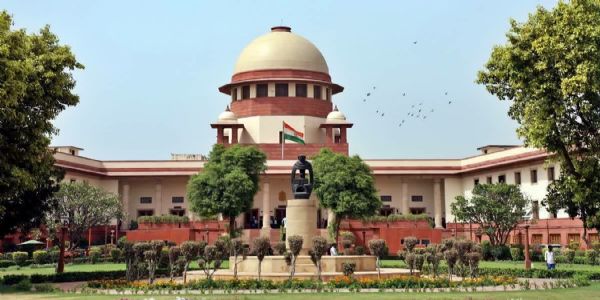
New Delhi, 27 October (H.S.): The Supreme Court has strongly reprimanded the Rajasthan government over alleged illegal mining and pollution in the Jojari, Bandi and Luni rivers, warning that it may order a Central Bureau of Investigation (CBI) probe if the state authorities fail to take corrective action.
A Bench comprising Justice Vikram Nath and Justice Sandeep Mehta was hearing suo motu proceedings concerning pollution in the Jojari river. The Court also raised concerns over contamination of the Bandi and Luni rivers. The matter is scheduled for its next hearing on November 27.
During the proceedings, the Court raised serious questions about the role of state officials, observing that the entire river system had been allowed to deteriorate under the watch of the authorities, who had allegedly remained silent spectators despite their responsibility to protect it.
The Bench particularly criticised the Mining Department and local administration, questioning how mining leases had subsequently been granted in areas where large-scale illegal mining had previously been identified. The Court expressed concern that such actions effectively amounted to legitimising activities that had earlier been found to be unlawful, and held that the authorities appeared to have failed in discharging their duties.
Additional Solicitor General S.V. Raju, appearing for the Rajasthan government, assured the Court that the matter would be examined.
When the argument concerning industrial viability and livelihoods was raised during the hearing, the Court made a pointed observation about the need to prioritise public health and environmental protection over narrow economic considerations.
“ The economic viability and livelihoods of a few thousand people cannot be compared with the lives of 20 lakh people. We cannot allow 20 lakh people to be forced to live in hellish conditions,” the Court observed.
The Bench also expressed concern over industrial units in Sanganer and adjoining areas that were allegedly operating without the requisite no-objection certificates (NOCs) from the pollution control authorities. It noted that textile and other industrial units were reportedly discharging toxic waste directly into rivers, aggravating the pollution crisis.
The Court further questioned the manner in which the High Flood Lines of the rivers had been determined, expressing concern that the river corridors appeared to have been deliberately represented as narrower than their actual recorded extent. Such an approach, it observed, raised serious concerns about the interpretation and implementation of its earlier directions.
The Supreme Court has previously imposed restrictions on construction and development activities within 100 metres of the riverbanks of the affected river system, pending the scientific identification and demarcation of the High Flood Lines and ecological buffer zones. It has also restrained the establishment of hazardous and polluting industries within 500 metres on either side of the rivers’ existing flood lines.
To strengthen monitoring and ensure coordinated action, the Court has also provided for an Integrated Coordination Group under the chairmanship of the Rajasthan Chief Secretary and a High-Level Ecosystem Oversight Committee headed by a retired judge.
The proceedings underscore the Court’s concern over persistent environmental degradation, alleged regulatory lapses and the need for effective measures to restore the Jojari-Bandi-Luni river system.
---------------
Hindusthan Samachar / Jun Sarkar
18 Aug 2026