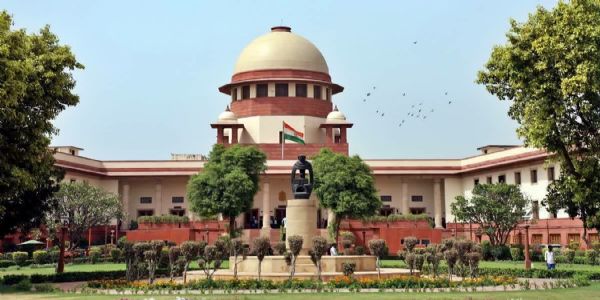
New Delhi, 27 October (H.S.): The Supreme Court on Tuesday sought the Central Government’s response to fresh petitions challenging official orders mandating the singing of all six stanzas of the national song ‘Vande Mataram’ at specified occasions. The Bench headed by Chief Justice of India Surya Kant tagged the new petitions with an earlier plea filed by Carnatic vocalist T. M. Krishna.
The Court was hearing petitions filed by B. D. Borkar and Balakrishnan Sathyabhama Mavoji. It scheduled the next detailed hearing in the matter for November 30.
The petitioners have argued that the government’s directive changes a practice followed for nearly 79 years, under which only the first two stanzas of the song were customarily sung at official and public gatherings. They contend that the complete six-stanza version, drawn from Bankim Chandra Chattopadhyay’s novel ‘Anandamath’, contains religious references, including invocations of Hindu goddesses.
According to the petitions, making the full version compulsory could infringe upon an individual’s freedom of conscience and religious freedom guaranteed under Article 25 of the Constitution. The petitioners have challenged the government’s orders on constitutional grounds, arguing that citizens should not be compelled to participate in a rendition that conflicts with their religious beliefs.
Carnatic vocalist T. M. Krishna had earlier filed a separate petition challenging the provisions of the amended Prevention of Insults to National Honour Act, which extend penal protection to the national song. The amendment makes intentionally preventing the singing of ‘Vande Mataram’ or disrupting an assembly engaged in singing it punishable by imprisonment of up to three years.
The petition questions Section 3 of the amended law and challenges the legal provisions that could expose individuals to criminal proceedings for obstructing the singing of the song.
On September 22, while hearing Krishna’s petition, the Supreme Court issued notice to the Centre. During the proceedings, the Bench orally observed that a person who refrains from singing some or all of the stanzas of ‘Vande Mataram’ should not face criminal action merely for exercising a conscientious objection.
The latest petitions have now been linked to the pending case, with the Court scheduled to take up the matter in detail on November 30.
---------------
Hindusthan Samachar / Jun Sarkar
18 Aug 2026