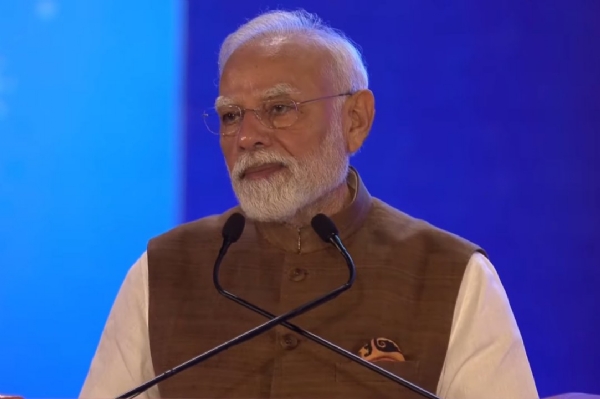
New Delhi, 27 October (H.S.): Prime Minister Narendra Modi on Tuesday said India was moving beyond merely adopting scientific and technological advancements developed elsewhere to creating new technologies, shaping their future direction and providing solutions to global challenges. He said the country must prepare itself not only to adopt emerging technologies but also to innovate and take a leading role in their development worldwide.
Addressing the gathering after inaugurating the Emerging Science, Technology and Innovation Conclave (ESTIC) 2026 at Bharat Mandapam in New Delhi, PM Modi said the skills, confidence and enthusiasm for innovation demonstrated by Indian youth offered a promising outlook for the country's future. He observed that, decades ago, science and technology in India largely meant adopting technologies developed elsewhere or making improvements to them. However, 21st-century India was advancing with a renewed sense of confidence and a willingness to embrace new ideas.
Citing India's response to the COVID-19 pandemic, the Prime Minister said that while several countries around the world faced challenges in securing vaccines, India developed its own vaccine, carried out vaccination on a massive scale and supplied vaccines to other countries. He said this demonstrated the confidence and capabilities of 21st-century India.
PM Modi highlighted India's achievements in space exploration, including reaching Mars in its maiden attempt and landing on the Moon's south polar region. He said the country was steadily strengthening its capabilities and confidence in areas such as nuclear energy, space technology, artificial intelligence (AI) and semiconductors.
Referring to progress in nuclear energy, the Prime Minister said a large-scale expansion of nuclear power would be essential to building a developed India. Dependence on imported nuclear fuel posed a challenge to energy security, he said, adding that the country was therefore developing its own fast breeder reactor technology.
He noted that, a few months ago, India's 500-megawatt Prototype Fast Breeder Reactor had achieved initial criticality for the first time, marking an important milestone towards long-term energy self-reliance.
PM Modi said one of India's major strengths lay in its ability to develop solutions on a large scale and make them accessible to ordinary citizens. The country's digital public infrastructure and 5G technology were prominent examples of this capability. He said India was working towards developing secure technological solutions that could be deployed widely and address real-world challenges.
The Prime Minister observed that science and technology were often viewed as instruments of power projection or conflict. India, however, believed that their fundamental purpose should be to serve humanity. The success of a technology, he said, should not be measured merely by how advanced it was, but by its ability to resolve practical problems. The true success of science lay in translating technologies developed in laboratories into real-world applications that improved the lives of ordinary citizens.
Describing research as the foundation of a country's technological capabilities and self-reliance, PM Modi said it enabled nations to find solutions to their own challenges and develop independence in critical technologies. Referring to the motto, Jai Vigyan, Jai Anusandhan (Hail Science, Hail Research), he said the government was continuously strengthening India's research ecosystem and accelerating the work of the Anusandhan National Research Foundation to help achieve the goal of a developed India.
The Prime Minister recalled that a commitment of Rs. 1 lakh crore for research, development and innovation had been announced from the same platform last year, adding that the initiative was beginning to yield results.
Over the past year, a commitment of approximately Rs. 12,000 crore had been made to help bring technologies developed in laboratories and ready for commercialisation to the market. Private investors were also participating in the initiative and had pledged to invest an additional Rs. 12,000 crore, matching the government's commitment. This had taken the total commitment towards research, development and innovation to Rs. 24,000 crore over the year, he said.
PM Modi said India's research ecosystem was expanding steadily. A decade ago, the country received fewer than 10,000 patent applications annually, whereas the figure had risen to 1.5 lakh last year. He described this increase as an indication of growing interest in research and innovation and a transformation in the country's scientific culture.
The Prime Minister stressed that scientists and research institutions must prepare not only for present-day requirements but also for future challenges. Semiconductors, quantum technology, biotechnology, advanced materials, robotics, space, clean energy and next-generation communication technologies were among the fields that would shape the future, he said. Promoting research and innovation in these areas would be crucial to strengthening India's technological capabilities and self-reliance.
He said Indian start-ups and companies were developing indigenous solutions across several emerging technology sectors. One start-up was working on wearable electroencephalography (EEG) technology to help understand brain activity. Indian companies were developing home-grown wireless and satellite communication solutions, while new products were being designed to meet specialised dietary and nutritional requirements. Work was also progressing on new technologies in the semiconductor sector.
PM Modi further noted that Indian researchers were exploring ways to utilise steel slag, a waste material generated by the steel industry, highlighting the country's efforts to find practical applications for industrial by-products.
Highlighting achievements in space technology, the Prime Minister said an Indian space start-up had successfully placed a satellite into orbit using an indigenous rocket in its maiden attempt this year. India had also developed the capability to dock satellites in space. He said Indian start-ups were introducing new solutions in space science, while the participation of young scientists and entrepreneurs in the sector continued to grow.
PM Modi said India had hosted the AI Impact Summit this year and unveiled its own AI model. He also noted that the first batches of domestically manufactured semiconductor chips had begun reaching overseas markets. In battery storage, India was working to build its capabilities by leveraging raw materials available within the country, he added.
Concluding his address, the Prime Minister said India, the world's largest youth-populated country, possessed both immense talent and a strong determination to innovate. The country needed to nurture a generation that would not merely participate in emerging fields of science and technology but lead them, he said.
Calling on young people to move forward with confidence, PM Modi urged them to embrace a spirit of determination and self-belief, summed up in the words: We can do it.
---------------
Hindusthan Samachar / Jun Sarkar
18 Aug 2026