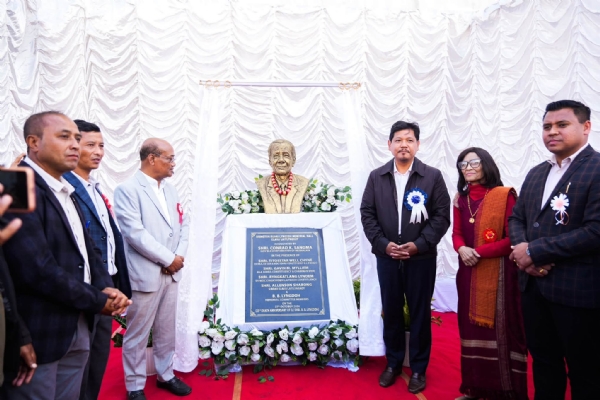
Shillong, 27 October (H.S.): The Brington Buhai Lyngdoh Memorial Hall was inaugurated by Meghalaya Chief Minister Conrad K. Sangma at Laitlyngkot, the birthplace of the former chief minister, on Tuesday, marking the 23rd death anniversary of the veteran leader, widely known as the Father of Coalition Politics in Meghalaya.
The inauguration paid tribute to Lyngdoh's contributions to Meghalaya's political development, including the movement for statehood, the strengthening of democratic institutions and the formation of coalition governments.
The memorial hall is expected to preserve his legacy and familiarise younger generations with the life, political vision and public service of one of Meghalaya's prominent political leaders.
Lyngdoh, who
died on October 27, 2003, at the age of 81, served as chief minister on four
occasions between 1979 and 2000. He played a significant role in the political
movement that led to Meghalaya attaining full statehood in 1972 and remained an
influential figure in the state’s political affairs for decades.
His ability to
bring together different political parties and lead coalition governments
earned him the distinction of being the Father of Coalition Politics. His
political career spanned a formative period in Meghalaya’s history, when
regional identity, indigenous rights and the creation of stable political
institutions were central to public life.
Beyond his role
as chief minister, Lyngdoh contributed to governance and development
initiatives. He advocated systematic land records through cadastral surveys,
supported the establishment of the North Eastern Indira Gandhi Regional
Institute of Health and Medical Sciences (NEIGRIHMS) and introduced the MLA
Scheme, which provided legislators with funds for local development works.
His approach to
public service also emphasised land, livelihoods, connectivity, education and
social harmony. These priorities reflected his broader vision of development
rooted in the needs and aspirations of Meghalaya’s people.
The
inauguration of the memorial hall at his native village serves as a tribute to
a leader whose political contributions extended beyond his tenure in office. It
also provides an opportunity to reflect on Meghalaya’s political history and
the role played by its early leaders in shaping the state’s institutions and
governance.
The occasion
was marked by renewed calls to preserve Lyngdoh’s legacy and ensure that his
contributions to Meghalaya’s statehood movement, democratic development and
coalition politics remain part of the collective memory of future generations.
Hindusthan Samachar / Abhijit Deb
18 Aug 2026
ED raids KPSC office, 20 other locations over Karnatak veterinary recruitment scam
ED raids KPSC office, 20 other locations over Karnatak veterinary recruitment scam..