New Delhi, 27 October (H.S.): Delhi Legislative Assembly Speaker Vijender Gupta on Tuesday emphasised that uniformity in legislative rules should not be interpreted as requiring identical procedures across all legislatures. He said the objective should be to strengthen common democratic standards while safeguarding the constitutional autonomy and distinctive identity of each legislative body.
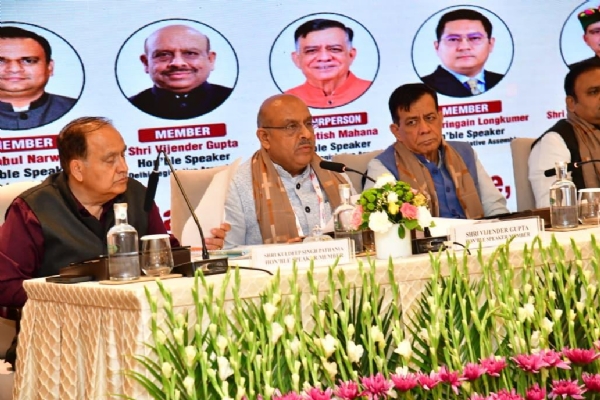
Gupta made these remarks while presenting Delhi’s suggestions at a meeting of the committee constituted to formulate model rules for uniformity in the conduct of business and procedures of legislative institutions across India. He stressed the need for comprehensive parliamentary reforms, including the adoption of gender-neutral language in legislative rules.
He said the continued use of masculine terminology in procedural rules, rooted in longstanding conventions associated with the General Clauses Act, 1897, should give way to language that reflects contemporary democratic values. The respect accorded to women and their contribution to the nation, he added, should also be reflected in the rules governing India’s democratic institutions.
The meeting was chaired by Uttar Pradesh Legislative Assembly Speaker Satish Mahana. Maharashtra Assembly Speaker Rahul Narwekar, Himachal Pradesh Assembly Speaker Kuldeep Singh Pathania, Karnataka Assembly Speaker Gurupadagouda Sanganagouda Patil, senior legislative officials and representatives from various legislatures attended the deliberations.
Welcoming the presiding officers, Gupta recalled the committee’s preliminary meeting held in Mysuru on May 12. He said the decision to develop a common procedural framework had been taken at the 85th All India Presiding Officers’ Conference in Patna.
Emphasising the importance of constitutional safeguards, Gupta said the model rules must account for the distinct legal frameworks governing Delhi, Puducherry and Jammu and Kashmir. Their legislatures function under specific constitutional provisions and special laws, including the Government of National Capital Territory of Delhi Act, 1991.
He also called for appropriate provisions for bicameral legislatures, covering Legislative Councils, their presiding officers, secretariat officials and coordination between the two Houses. He highlighted the need to clearly define procedures for electing presiding officers, including Speakers and Deputy Speakers, nominating members to the panel of chairpersons, and delegating the Speaker’s functions to other authorised officials.
On the functioning of legislative assemblies, Gupta supported holding three sessions annually — the Budget, Monsoon and Winter sessions — and ensuring a minimum of 30 sittings each year in every state legislature. The issue had also been discussed at the 86th All India Presiding Officers’ Conference.
To make parliamentary procedures more flexible and effective, he proposed avoiding unnecessary overlap between Zero Hour and Special Mentions, limiting the number of adjournment motions to one per sitting, and leaving the duration of debates to the discretion of the Speaker or the House. He also questioned the proposal to mandate a minimum gap of five days before convening the next sitting of an adjourned House.
Highlighting legislative scrutiny as a crucial component of parliamentary reform, Gupta said every Bill should be accompanied by details of its financial, administrative and legal implications. These should include a financial memorandum and an explanation of provisions involving the delegation of legislative powers.
He further stressed the need to retain the statutory requirement for an authorised English text of laws in Delhi. He also called for proper documentation whenever procedural rules were relaxed in exceptional circumstances.
To encourage greater public participation, Gupta proposed removing outdated colonial-era terminology from petition forms, recognising regional languages and permitting the submission of petitions through authenticated electronic means. He also referred to a Delhi Assembly procedure requiring private members to submit the full text of their proposed resolutions along with their notices so that their admissibility can be examined in advance.
Gupta supported provisions allowing the Secretary to authenticate Bills in exceptional circumstances, while emphasising the need for appropriate legal safeguards.
On legislative privileges, he suggested reconsidering the proposal to limit the period of suspension of members to a maximum of 30 days. He said suspension and expulsion were distinct forms of disciplinary action and maintained that legislative Houses should retain the authority to take disciplinary measures within the framework of the law, including imprisonment and other appropriate penalties where legally permissible.
He also called for clear procedures to address complaints relating to members’ conduct, discretion for the Speaker to permit the use of the Assembly chamber for other purposes in exceptional circumstances, and provisions establishing the Speaker’s decisions on the interpretation of procedural rules as final.
---------------
Hindusthan Samachar / Jun Sarkar
18 Aug 2026