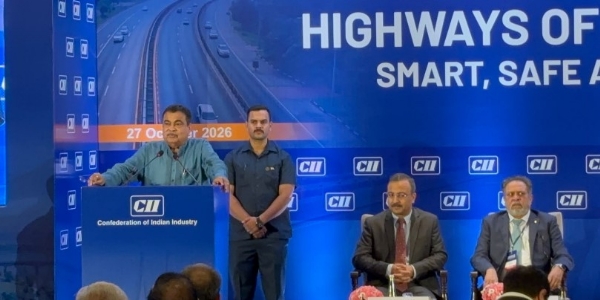
New Delhi, 27 October (H.S.): Union Minister for Road Transport and Highways Nitin Gadkari said investment in roads and infrastructure has a far-reaching impact on the economy, stating that every Rs. 100 spent on infrastructure generates an economic and gross domestic product (GDP) impact equivalent to Rs. 325.
He emphasised that promoting agriculture, industry, trade and investment would not be possible without robust infrastructure, reliable electricity and adequate water supplies.
Gadkari made these remarks on Tuesday while addressing the Confederation of Indian Industry’s (CII) national conference, titled ‘Highways of India’s Future: Smart, Safe and Sustainable’, in New Delhi. He outlined the government’s initiatives concerning road construction, economic growth, logistics costs, construction quality and alternative fuels.
The minister said reducing logistics costs was essential to making India more competitive in international markets. Two years ago, logistics costs accounted for approximately 8 per cent of China’s GDP, compared with 16 per cent in India, he said. To narrow this gap, the country is developing green expressways and an extensive road network featuring carriageways ranging from two to six lanes.
Gadkari said India’s total national highway network had expanded from 91,287 km during 2004–2014 to 146,572 km between 2014 and 2026. The length of roads with four or more lanes had increased from 18,278 km to 49,260 km, while the high-speed corridor network had grown from 557 km to 6,788 km.
He also highlighted a proposed combined rail-and-road tunnel beneath the Brahmaputra River in Assam, estimated to cost Rs. 22,000 crore. Over the next five to seven years, tunnel projects associated with hydropower, metro rail and highways worth Rs. 7 lakh crore to Rs. 8 lakh crore are expected to be developed, he said.
The minister said an advanced artificial intelligence-based traffic management system was being introduced across the first phase of the national highway network, covering 10,000 km. Under the system, cameras would detect violations such as improper lane discipline and driving without helmets or seat belts, with electronic challans issued to offenders.
He also urged industry representatives to promote the use of electricity, hydrogen and biofuels instead of diesel in construction equipment.
Gadkari said the pace of national highway construction had increased from 9 km per day to 37 km per day. Infrastructure expenditure had risen from Rs. 2 lakh crore to Rs. 16 lakh crore, while the budgetary allocation for the Ministry of Road Transport and Highways had increased to Rs. 3.1 lakh crore.
Work is underway on 25 greenfield corridors spanning 7,500 km at an estimated cost of Rs. 4 lakh crore. Projects worth Rs. 1 lakh crore related to religious tourism and tunnel projects valued at Rs. 2 lakh crore are also in progress, he said.
Emphasising the importance of construction quality, the minister said he had reviewed 700 to 800 projects over the past three to four months. He added that stricter monitoring had helped reduce road defects by 70 per cent compared with the previous year.
Gadkari also highlighted progress in the use of sustainable materials for road construction. A one-kilometre stretch of the Nagpur–Jabalpur highway has been built using bio-bitumen, he said. India consumes around 12 million tonnes of bitumen annually, of which 50 to 60 per cent has to be imported. Producing bio-bitumen and sustainable aviation fuel from crop residue and other waste materials could help reduce the country’s dependence on imports.
He added that work was underway on 3,000 bio-compressed natural gas (bio-CNG) projects across the country.
The minister said the Indian automobile industry had expanded from Rs. 14 lakh crore when he assumed office to Rs. 22 lakh crore at present. He reiterated his goal of making India the world’s largest automobile industry within the next five years, identifying the vehicle scrappage policy, electric vehicles and emerging battery technologies as important drivers of future growth.
Gadkari also said that 360 ropeway, cable car and funicular railway projects were being developed across the country to improve connectivity and support tourism.
---------------
Hindusthan Samachar / Jun Sarkar
18 Aug 2026