New Delhi, 27 October (H.S.): Union Minister for Road Transport and Highways Nitin Gadkari on Tuesday said every pothole on National Highways would be identified and accountability fixed, warning that companies, contractors, consultants and officials compromising construction quality could face financial penalties and blacklisting.
Nitin Gadkari said he had personally been monitoring road projects over the past few months, resulting in a 30 per cent reduction in quality-related problems. He expressed confidence that the remaining issues would also be resolved over the next two years.
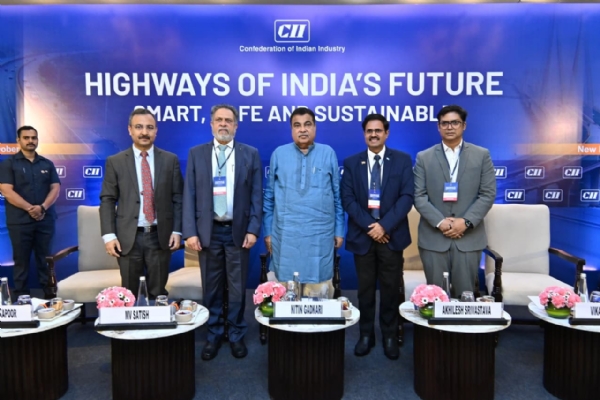
The Minister was speaking at the Confederation of Indian Industry’s (CII) national conference, titled ‘Highways of India’s Future: Smart, Safe and Sustainable’, in New Delhi. The conference brought together industry representatives and experts to deliberate on road construction quality, road safety, logistics costs, emerging technologies, sustainable infrastructure and the adoption of alternative fuels.
Among those attending were M.V. Satish, Chairman of CII’s National Committee on Roads and Highways; Akhilesh Srivastava, Co-Chairman of CII’s National Task Force on Road Safety and President of the India ITS Forum; and John Prasad Kandamparambil, Head of Institutional Business at Indian Oil Corporation.
Nitin Gadkari said complaints shared by citizens on social media were helping authorities identify deficiencies in road infrastructure. He urged people to report poor road conditions on social media platforms so that the problems could be brought to the attention of the concerned authorities.
He added that several companies manufacturing bearings and expansion joints had already been blacklisted over quality deficiencies. The Ministry, he said, was following a policy of zero tolerance towards compromises in road construction quality.
Highlighting the use of technology in monitoring road infrastructure,Nitin Gadkari said the Network Survey Vehicle was equipped with systems capable of assessing road conditions and surface quality while travelling at speeds of 40 to 80 kilometres per hour.
The National Highways Authority of India (NHAI) is using the technology on the Ministry’s directions. It enables authorities to monitor road quality, plan maintenance and make relevant data available through an artificial intelligence-based portal, helping improve the efficiency of road management.
Emphasising the importance of infrastructure development for economic growth,Nitin Gadkari said robust infrastructure was essential for India to achieve its ambition of becoming a five-trillion-dollar economy. Development in areas such as water, electricity, transport and communications, he noted, was critical to industrial expansion, trade and investment.
He cited the multiplier effect of infrastructure spending, stating that an expenditure of Rs. 100 on infrastructure could generate an economic impact equivalent to Rs. 325. The government, he said, was therefore according the construction of quality roads the highest priority.
The Minister also said he was in discussions with the Bihar Chief Minister regarding a proposed memorandum of understanding under which the NHAI would undertake desilting of rivers without charging a fee. The excavated silt would then be used in highway construction.
According to Nitin Gadkari, the initiative could help reduce the risk of flooding in Bihar while making productive use of the material removed from riverbeds.
Addressing the conference, M.V. Satish said roads served purposes beyond facilitating trade, helping connect people and enabling the exchange of ideas, innovation, culture and prosperity.
He noted that India had one of the world’s largest road networks and emphasised the need to make future road connectivity faster, more sustainable, resource-efficient, environmentally friendly, safer and better equipped to incorporate emerging technologies.
John Prasad Kandamparambil of Indian Oil Corporation said infrastructure investment was a key foundation for long-term business growth. He observed that road construction extended beyond bitumen, involving a range of sectors and materials, including aggregates, fuel, bitumen and advanced construction materials.
---------------
Hindusthan Samachar / Jun Sarkar
18 Aug 2026