New Delhi, 25 October (H.S.): Prime Minister Narendra Modi on Sunday paid tribute to Narinder Singh Kapany, widely recognised as the “Father of Fibre Optics”, and Bhai Parmanand, a founding member of the Ghadar Party, during the 139th episode of his monthly radio programme, ‘Mann Ki Baat’. Highlighting their contributions to science and India’s freedom struggle, respectively, he encouraged young people to read about the country’s eminent personalities and draw inspiration from their lives. The Prime Minister also urged citizens to participate in the ‘Run for Unity’ on October 31 and extended his greetings for the upcoming festivals.
PM Modi also paid homage to Maharishi Valmiki, noting that the Ramayana, composed by the revered sage, continues to inspire generations with its timeless wisdom and teachings. He said the epic underscores the importance of perseverance, service, compassion and social harmony.
The Prime Minister’s monthly radio programme, ‘Mann Ki Baat’, has completed 12 years. He began the programme on the auspicious occasion of Vijayadashami 12 years ago, choosing radio as a medium to connect with people across the country. Reflecting on this journey of communication, Modi described it as a pilgrimage that had enabled him to understand the efforts of ordinary citizens and acknowledge their contributions.
Addressing listeners during the 139th episode, he said, “For me, Mann Ki Baat is no less than a pilgrimage. It is a journey to understand our people’s efforts in depth and to salute their contributions.”
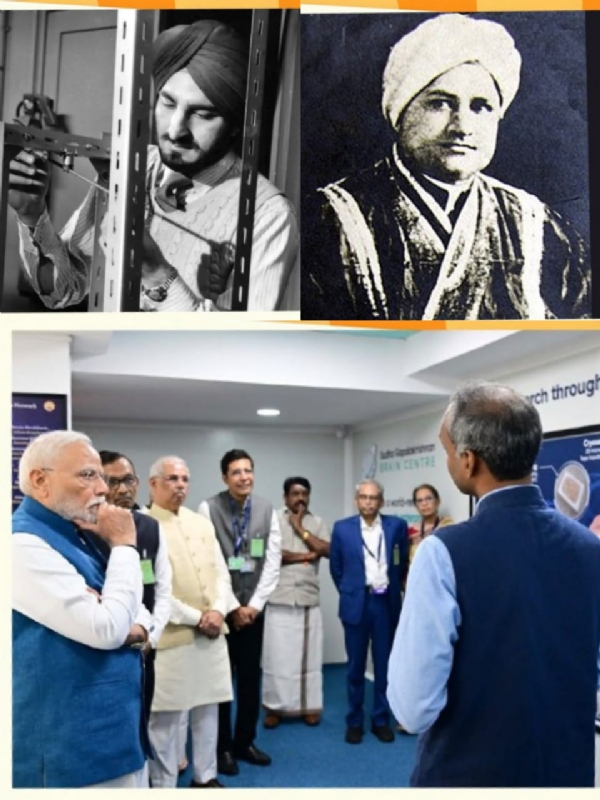
Recalling Narinder Singh Kapany, whose birth anniversary falls on October 31, the Prime Minister said his pioneering work had transformed modern communications. Known around the world as the “Father of Fibre Optics”, Kapany was born in Punjab’s Moga district. His groundbreaking research opened new avenues in communication technology. Modi observed that it was difficult to imagine today’s internet and digital communication without the technology Kapany helped advance.
The Prime Minister also remembered Bhai Parmanand, a prominent revolutionary of India’s freedom struggle, whose birth anniversary falls on November 4. He described Parmanand’s life as an enduring example of courage, sacrifice and service to the nation, adding that his contribution to the independence movement would always be remembered.
Parmanand drew considerable inspiration from his deep association with the Arya Samaj. He was involved in the organisation’s activities in South Africa and Guyana, and met Mahatma Gandhi in South Africa. He was among the founding members of the Ghadar Party and is credited with encouraging Lala Har Dayal to travel to the United States.
As in previous episodes, the Prime Minister shared several inspiring stories highlighting grassroots initiatives, traditional knowledge, sustainable agriculture, scientific research and public service.
One such example concerned efforts to revive traditional agricultural practices in Punjab.PM Modi said the Kheti Virasat Mission, an organisation working in the state, was promoting natural cotton cultivation in the Malwa region. The initiative, named ‘Nav-Trinjan’, aims to revive traditional farming practices while encouraging more sustainable approaches to cotton production.
The Prime Minister also highlighted the renewed interest in traditional millet cultivation in Meghalaya and Nagaland, noting that it was creating fresh opportunities for farmers in the Northeast.
In Khanduli village in Meghalaya’s West Jaintia Hills district, millet has been an integral part of the local diet for generations. However, the number of farmers cultivating the crop had declined over time. In response, two friends from the village took the initiative to develop new products using millet. They began making cookies, cakes, muffins and food products for infants from the traditional grain. Their efforts helped boost sales of millet-based products and generate greater demand for the crop.
PM Modi also drew attention to community-led efforts to rejuvenate the Heval River in Uttarakhand. He said residents of Tehri Garhwal had joined hands with the local administration to launch a campaign to restore the river and revive natural water sources. Measures were undertaken to conserve rainwater, facilitate groundwater recharge and plant a large number of trees. These collective efforts helped breathe new life into the river and contributed to the restoration of dozens of natural springs.
Highlighting advances in neuroscience, the Prime Minister said the Indian Institute of Technology Madras was pursuing research to deepen scientific understanding of the human brain. He referred to the inauguration of the Sudha Gopalakrishnan Brain Centre, which has developed a platform for producing high-resolution, three-dimensional digital images of the human brain. The centre aims to map and study 100 human brains in meticulous detail, supporting further research into the structure and functioning of the brain.
The Prime Minister also highlighted the role of the eSanjeevani telemedicine service in extending healthcare to people living in remote areas, citing examples of patients who received timely specialist advice through the platform.
On Baratang Island in the Andaman and Nicobar Islands, a seven-year-old child from the Jarawa community, named Oho-Tahane, developed a high fever and experienced breathing difficulties. Local healthcare workers used eSanjeevani to consult a specialist doctor, who diagnosed the child with pneumonia. After the child came under the specialist’s supervision, his condition improved rapidly.
In another case, around 60-year-old Kunhi Koya, a resident of Kalpeni in Lakshadweep, suddenly fell ill. Healthcare workers used eSanjeevani to contact an experienced doctor based in Kavaratti. The doctor guided the local medical team, helping provide relief to the patient.
Reiterating his appeal for ‘Vocal for Local’, PM Modi urged citizens to strengthen the initiative by choosing locally made products and supporting domestic producers. He noted that Bihar’s makhana, or fox nuts, and Karnataka’s arhar dal were exploring new markets around the world.
He also highlighted how distinctive packaging that showcases the artistic traditions of Maharashtra’s tribal communities was helping their products gain recognition. The growing popularity of khadi, he added, was providing valuable support to traditional artisans and helping sustain their livelihoods.
Hindusthan Samachar / Jun Sarkar
18 Aug 2026