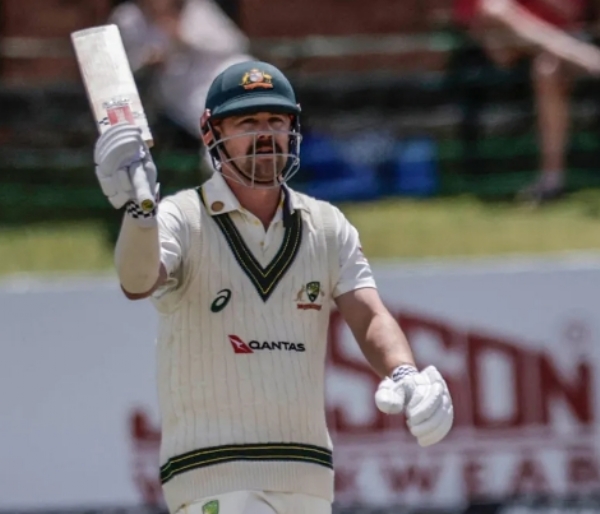
Cape Town, 24 October (H.S.): Australia opener Travis Head has called for greater collective responsibility from the team’s batting line-up following their crushing defeat to South Africa in the second Test at Gqeberha, stressing that the ability to build substantial partnerships will be crucial to Australia’s hopes of bouncing back in Cape Town.
Head acknowledged that while individual Australian batters had produced impressive innings over the past few months, the team had struggled to translate those performances into sustained collective success. He expressed hope that Australia would address this weakness in the third Test at Newlands, scheduled to begin on October 27.
Speaking to Cricket Australia after the defeat, Head candidly assessed the team’s performance in Gqeberha. “We had a very poor day. If we hadn’t been bowled out for 99, there was a good chance the Test would have ended in a draw. It is quite clear what we did wrong,” he said, acknowledging that an otherwise strong Australian side had endured a disappointing week.
Across seven innings in four Tests against Bangladesh and South Africa, Australian batters had registered six individual scores of 50 or more. Head himself scored 121 in Gqeberha, while Cameron Green contributed 104 in Darwin and 67 in Mackay. Matthew Renshaw made 190 and 82 in Durban, and Steve Smith scored 71 in the second innings at Darwin.
Despite these individual achievements, Australia have struggled to maintain consistent batting partnerships. In the first innings at Gqeberha, the visitors were dismissed for just 99, with Smith top-scoring with 28.
“We had spoken about this before the series as well. Each time, a different player has produced a good performance, but we haven’t been able to bat collectively in the way we need to as a team,” Head said.
He praised Renshaw’s recent performances, describing his innings the previous week as outstanding, and acknowledged the importance of individual contributions in winning matches. However, he emphasised that sustained support from the rest of the batting order was equally essential.
According to Head, the lack of substantial partnerships among Australia’s top five batters has become increasingly apparent in recent Test matches. During the second innings at Gqeberha, Head and Marnus Labuschagne shared a 92-run stand. It was only the fourth partnership of at least 50 runs among the top five Australian batters during the recent run of matches under discussion.
By contrast, in each of the four Tests Australia won during the previous Ashes series, the top five batters produced at least one partnership worth 80 runs or more.
“Building big partnerships has long been one of our strengths. That is how matches are won, but we haven’t managed to do it over the past few months. It is difficult to pinpoint the reason. We are facing some outstanding bowling attacks in challenging conditions, but it is not as though we are not trying,” Head said.
Head scored his century in Gqeberha after facing 190 deliveries, demonstrating patience alongside his attacking instincts. His innings helped Australia resist South Africa’s bowling attack in the second innings, although the visitors could not overcome the substantial deficit created by their first-innings collapse.
With Cameron Green and Josh Inglis among the players being considered for the next Test, changes to Australia’s batting order are also a possibility. Renshaw’s return to the opening role could allow Head to move elsewhere in the line-up, while Green may also come into contention.
Head, however, said he was comfortable batting in different positions and did not consider a change in the order a major obstacle.
“I don’t see much difference between batting at number one and number five. The ball is still red, and you have to keep using your skills as effectively as possible. Sometimes you come in after three quick wickets, sometimes you face the second new ball, and sometimes you arrive at the crease when the team is in a strong position. Whatever the batting position, the process remains the same,” he said.
Australia will now look to turn individual contributions into stronger collective performances and build the partnerships needed to challenge South Africa in the series decider. The three-Test series is level at 1-1 after South Africa won the second Test by an innings and 31 runs, setting up a decisive contest at Newlands in Cape Town from October 27 to 31.
---------------
Hindusthan Samachar / Jun Sarkar
18 Aug 2026
Cincinnati Open: Williams Sisters Fall in First Round, Kostyuk-Stearns Duo Edges Them Out in Super Tiebreak

18 Aug 2026