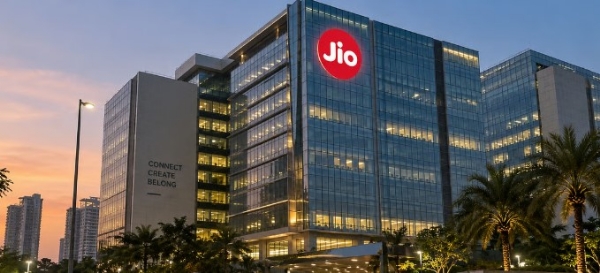
New Delhi, 24 October (H.S.): Jio Platforms’ initial public offering (IPO) has set several new benchmarks in the Indian capital market, emerging as the country’s largest-ever public issue at Rs 30,213 crore. The offering has also created a global record, becoming the first IPO in the world to attract more than one crore applications. The unprecedented investor response was evident from the fact that the issue was fully subscribed within approximately 100 minutes of opening.
The IPO remained open for subscription from October 21 to 23. According to data from the National Stock Exchange (NSE), the issue was subscribed 22.19 times by the close of bidding on the final day. Qualified institutional buyers (QIBs) demonstrated the strongest demand, subscribing to their reserved portion 70.55 times. The non-institutional investor (NII) category was subscribed 14 times, while the portions reserved for retail investors and employees were subscribed 2.72 times and 2.91 times, respectively.
The number of applications received for the issue also established a new global record. Jio Platforms attracted more than one crore applications from individual investors, surpassing the previous reported record held by Waaree Energies, whose IPO received approximately 97.3 lakh applications. The participation of investors across categories, ranging from retail applicants to large institutional investors, highlights the growing appetite for public offerings in India’s primary market.
In terms of issue size, Jio Platforms has surpassed several major offerings that previously dominated the Indian IPO market. Hyundai Motor India had held the record for the country’s largest IPO, raising Rs 27,870 crore. It was followed by the National Stock Exchange of India’s proposed Rs 22,561-crore offering and the Life Insurance Corporation of India’s Rs 21,008-crore IPO. Jio Platforms’ Rs 30,213-crore issue has overtaken these benchmarks.
Another distinguishing feature of the offering is its structure. The IPO comprises an entirely fresh issue of approximately 27 crore shares, with no offer-for-sale component through which existing shareholders would sell their holdings. Consequently, the proceeds from the share issue will accrue to the company rather than to existing investors. Neither Reliance Industries nor other existing shareholders, including Meta and Google, offered their shares for sale as part of the IPO. An offering of this scale based entirely on newly issued shares represents a significant development in the Indian primary market.
The exceptional demand also prompted changes to the bidding arrangements. IPO applications on Indian stock exchanges generally follow a prescribed daily bidding window. However, in view of the extraordinary response to Jio Platforms’ offering, the Bombay Stock Exchange (BSE) and the NSE extended the bidding hours from 9 am to 7 pm. The extended window was intended to give investors additional time to submit their applications.
The value of bids received further underlined the scale of investor interest. Including anchor investor demand, the total value of bids for Jio Platforms’ IPO reached approximately Rs 7.4 lakh crore. Excluding anchor investors, bids for the public issue exceeded Rs 4.9 lakh crore. Shares worth approximately Rs 8,110 crore had been allocated to anchor investors, whose bids for this portion reportedly amounted to around Rs 2.5 lakh crore.
Based on the upper end of the IPO price band of Rs 1,119 per share, Jio Platforms’ implied market capitalisation is estimated at approximately Rs 10.3 lakh crore. At this valuation, the company could rank among India’s largest listed companies following its stock market debut. Its actual market capitalisation, however, will depend on the prevailing share price once trading begins.
Market experts believe the IPO also reflects the changing dynamics of corporate fundraising in India. Strong participation in large public offerings, sustained investor interest in the telecommunications and digital services sectors, and the use of fresh equity to raise capital are among the key features underscored by the issue.
Nevertheless, analysts caution that heavy subscription or a high estimated valuation does not guarantee a strong listing or subsequent share-price appreciation. The stock’s performance after listing will depend on broader market conditions, the company’s business prospects and the level of investor demand in the secondary market.
---------------
Hindusthan Samachar / Jun Sarkar