New Delhi, 24 October (H.S.):
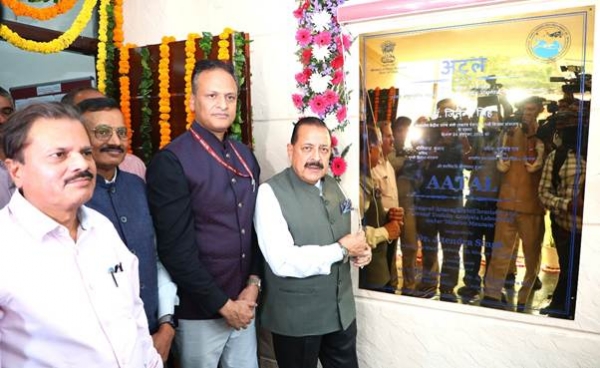
A new laboratory designed to identify the sources of air pollution and analyse its composition was inaugurated on Saturday to help tackle deteriorating air quality across Delhi-NCR. The Integrated Atmospheric Chemistry and Aerosol Toxicity Analysis Laboratory (AATAL), described as a first-of-its-kind facility, will not only measure pollution levels but also determine where pollutants originate and which factors are responsible for their presence in the atmosphere.
The laboratory has been established under Mission Mausam, an initiative launched by Prime Minister Narendra Modi. Its objective is to improve scientific understanding of the causes of air pollution and provide evidence to help authorities formulate and implement more effective measures to address the problem.
Inaugurating the facility, Union Minister of State Dr Jitendra Singh, who is also Minister of State in the Prime Minister’s Office, said discussions on air pollution had so far largely focused on a city’s Air Quality Index (AQI). The new laboratory, he explained, would go beyond reporting pollution levels to identify the types of harmful particles present in the air, trace their sources and assess their potential implications for human health.
He emphasised that merely measuring the intensity of pollution was not sufficient to address the problem. It was equally important to establish the extent to which different sources contributed to deteriorating air quality.
The laboratory will help identify pollution arising from vehicular emissions, industrial activities, stubble burning, construction work and road dust. It will also assess pollution transported into Delhi-NCR from surrounding areas, providing a more comprehensive picture of the factors affecting air quality across the region.
Citing an example, Dr Singh said data displayed on the laboratory’s monitoring screen indicated that the transport sector was contributing approximately 25 per cent of Delhi’s pollution at that time, when the recorded pollution level was around 180. Such source-specific information could help authorities identify the principal contributors to poor air quality and take targeted corrective action.
The facility is equipped with advanced instruments capable of analysing fine particulate matter, including PM2.5, as well as metals and other potentially harmful substances present in the atmosphere. This analysis will help scientists determine the composition of airborne pollutants and better understand their possible effects on human health.
The laboratory has also been integrated with the Indian Institute of Tropical Meteorology’s (IITM) AIRWISE system, which will enable air-quality forecasts for different parts of Delhi over the next 72 hours, or three days.
The system can assess air quality at a spatial resolution of approximately 400 metres, helping identify localised areas where pollution levels may rise and determine the likely factors contributing to such deterioration. This high-resolution forecasting capability is expected to provide authorities with more precise information for planning preventive interventions.
Dr Sachin D. Ghude, the project director, said the facility would enable agencies to receive advance information about potential increases in pollution and take necessary measures in a timely manner. The data generated by the laboratory will support the Commission for Air Quality Management (CAQM) and other relevant agencies in identifying major pollution sources and determining which sectors and locations require priority attention.
The findings are also expected to strengthen the implementation of the Graded Response Action Plan (GRAP), which prescribes measures to address varying levels of air pollution. By combining scientific measurements with advance forecasts and source identification, the new facility could help authorities design more targeted responses rather than relying solely on overall AQI readings.
The launch of AATAL marks a step towards a more evidence-based approach to air-pollution management in Delhi-NCR. Its effectiveness will depend on how efficiently the scientific data is translated into timely action by the agencies responsible for controlling emissions and improving air quality.
---------------
Hindusthan Samachar / Jun Sarkar
18 Aug 2026