New Delhi, 23 October (H.S.): Vice-President C. P. Radhakrishnan on Friday said the benefits of innovation and emerging technologies must be accessible to all humanity rather than being confined to the exclusive possession of any one country. Emphasising that “India’s advantage is humanity’s advantage”, he said the vision of a Developed India by 2047 was not merely an aspiration but also a responsibility that required the active participation of every citizen.
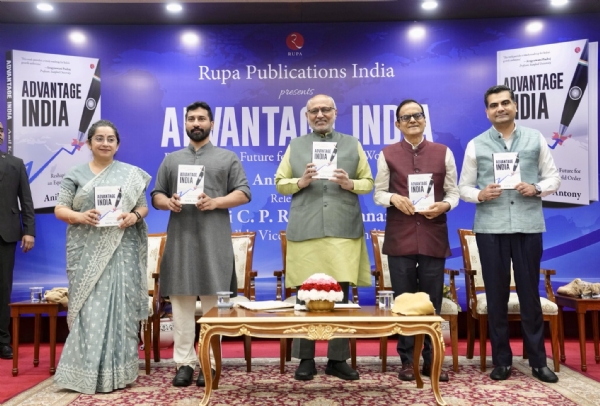
Radhakrishnan made these remarks while releasing Anil K. Antony’s book, Advantage India: Reshaping the Future for an Equitable World, at the Vice-President’s Enclave in New Delhi. Congratulating the author and Rupa Publications on the publication, he said the book highlighted India’s remarkable transformation and the opportunities available to the country in a rapidly changing world. Drawing on his experience in technology, business and public policy, Antony has examined India’s emerging capabilities and its expanding role in the international order, the Vice-President observed.
Radhakrishnan said India’s civilisational heritage, democratic traditions, demographic dividend, growing economy, strong institutions and expanding technological capabilities constituted the country’s distinctive strengths. Referring to India’s development journey under the leadership of Prime Minister Narendra Modi, he said more than 250 million people had been lifted out of extreme poverty. Initiatives in education, housing, sanitation, healthcare and food security had strengthened dignity and social protection in the lives of millions of citizens, he added.
The Vice-President said inclusive development remained a cornerstone of India’s progress, with the empowerment of women, young people, farmers and disadvantaged sections playing a central role. He noted that the emergence of more than three crore Lakhpati Didis reflected the success of women-led development. He also highlighted the expansion of educational and healthcare infrastructure through the establishment of new Indian Institutes of Technology (IITs), All India Institutes of Medical Sciences (AIIMS), medical colleges and other institutions of higher learning. Improvements in connectivity through Vande Bharat trains, airports, highways and railway stations had further strengthened the country’s infrastructure, he said.
Referring to technological advancement, Radhakrishnan recalled that the introduction of computers in India had initially prompted apprehensions. However, the country subsequently emerged as a major global force in the information technology sector. He said emerging technologies such as artificial intelligence (AI) and machine learning presented similar opportunities for India. Leadership would be crucial in ensuring that these technologies were harnessed to advance society and promote public welfare, he added.
Highlighting the vision of Aatmanirbhar Bharat, the Vice-President said India had made significant progress in indigenous manufacturing across various sectors. Referring to the recent induction of the indigenously built multipurpose vessel INS Samarthak into the Indian Navy, he described it as an example of the country’s expanding domestic defence manufacturing capabilities.
On India’s growing global role, Radhakrishnan said the country’s diplomatic approach had undergone a significant transformation, accompanied by greater international engagement, influence and confidence. He highlighted India’s role during its G20 presidency and its efforts to advance the principle of Vasudhaiva Kutumbakam, meaning “the world is one family”. He also underscored India’s contribution to the inclusion of the African Union in the G20 and the country’s emergence as a prominent voice of the Global South.
The Vice-President said Vasudhaiva Kutumbakam was not merely a slogan but a guiding philosophy for India. Recalling the country’s response during the COVID-19 pandemic, he said India had conducted an extensive vaccination drive while also supplying life-saving vaccines to more than 100 countries. This, he said, reflected India’s commitment to global solidarity and service to humanity.
Radhakrishnan emphasised that all sovereign nations were equal and deserved to be treated equally. The benefits of every new innovation and technological advancement, he said, should extend to humanity as a whole. Calling for a more equitable approach to technological development, he stressed that its benefits must be shared so that they could be used for the welfare of all people.
The Vice-President said achieving the goal of a Developed India by 2047 required collective commitment guided by the principle of “Nation First”. Nation-building could not be accomplished by the government alone, he observed, adding that every citizen had an active role to play in the process.
Expressing hope that the book would encourage young Indians to engage more deeply with technology, public policy, economics, international relations and nation-building, Radhakrishnan said such engagement was important for shaping India’s future and strengthening its contribution to the world.
Those present at the event included Professor Ajay Sood, Principal Scientific Adviser to the Government of India; Dr. Shamika Ravi, economist and member of the Economic Advisory Council to the Prime Minister; author Anil K. Antony; Kapish Mehra, Managing Editor of Rupa Publications; diplomats and other dignitaries.
---------------
Hindusthan Samachar / Jun Sarkar

18 Aug 2026