




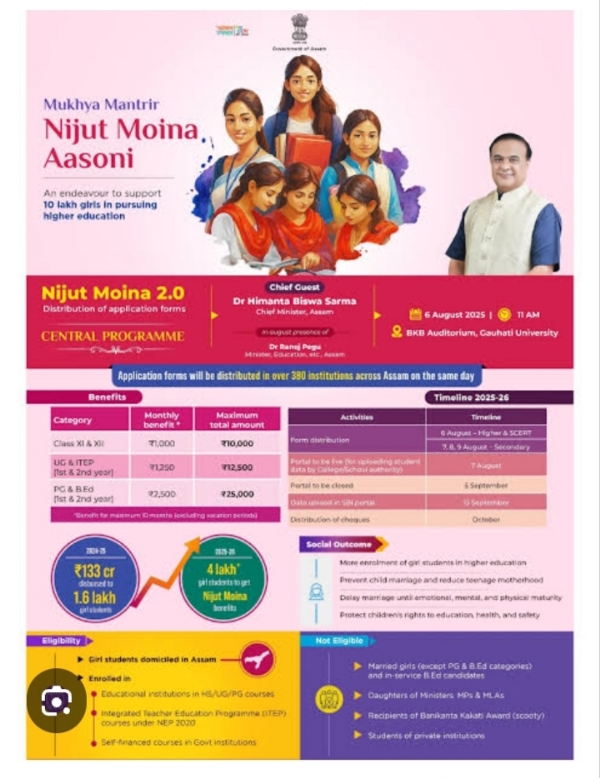
Guwahati, 23 October (HS): Assam’s Mukhya Mantrir Nijut Moina Aasoni is emerging as an important initiative to encourage girls to pursue higher education, reduce the financial burden on families and combat the social evil of child marriage. Launched under the leadership of Chief Minister Himanta Biswa Sarma, the flagship welfare scheme seeks to ensure that financial constraints do not force girls to abandon their education or enter marriage before completing their studies.
By providing monthly financial assistance to eligible girl students, the scheme aims to create an environment in which education becomes a practical and accessible choice for young women, particularly those from families struggling to meet the expenses of higher secondary and college education.
The government launched Nijut Moina 2.0 on October 15, 2026, releasing the first monthly instalment for the current academic year to more than 4.39 lakh students. The expansion reflects the state government's continued emphasis on female education and empowerment.
Financial Support to Keep Girls in Classrooms
Under the scheme, eligible students receive financial assistance through the Direct Benefit Transfer (DBT) system into their Aadhaar-seeded bank accounts. The assistance is provided for up to 10 months in an academic year, subject to the applicable scheme guidelines.
Students studying in Class XI receive ₹1,000 per month, amounting to ₹10,000 annually. Undergraduate students pursuing courses such as BA, BSc and BCom receive ₹1,250 per month, or ₹12,500 annually. Those pursuing postgraduate courses and B.Ed programmes receive ₹2,500 per month, taking their annual assistance to ₹25,000.
The financial support can help families meet education-related expenses, including transportation, books, stationery and other study requirements. For households where even relatively small expenses can become obstacles to continuing education, regular assistance can provide meaningful relief.
More importantly, the scheme offers families an additional reason to prioritise their daughters' education and support their continued participation in academic life.
An Intervention Against Child Marriage
One of the central objectives of the Nijut Moina scheme is to discourage child marriage by encouraging girls to remain enrolled in educational institutions. Continued access to education can help delay early marriage, strengthen awareness of individual rights and open up opportunities for employment and financial independence.
When a girl remains in school or college, she is more likely to have access to teachers, peers, educational resources and information about future career options. Continued education can also strengthen her ability to make informed decisions about her life.
The monthly assistance is intended to reduce the economic pressures that may otherwise encourage families to discontinue a daughter's education. By linking financial support with continued enrolment, the scheme seeks to make education a sustained priority rather than a temporary aspiration.
However, the long-term impact on child marriage will also depend on community participation, awareness campaigns, effective enforcement of child protection laws and the availability of accessible educational institutions.
Reducing the Financial Burden on Families
For many families, the cost of educating a daughter extends beyond admission fees. Daily transportation, learning materials, examination-related expenses and other necessities can collectively become a significant burden.
The Nijut Moina scheme addresses part of this challenge by providing direct financial assistance to eligible students. Although the grant may not cover all educational expenses, it can help families manage recurring costs and reduce the pressure on household finances.
The support also recognises that financial barriers can affect educational continuity even when students are academically capable and willing to study. By easing some of these expenses, the government aims to improve girls' access to higher secondary, undergraduate and postgraduate education.
The scheme is open to eligible girl students irrespective of caste or financial background, subject to institutional and other prescribed conditions. Students must meet the applicable eligibility requirements, including residency, enrolment, attendance and marital-status provisions.
From Educational Access to Women's Empowerment
The significance of the scheme extends beyond immediate financial assistance. Higher educational attainment can improve access to employment, professional training and opportunities for economic independence. Educated women can also contribute more effectively to household decision-making and participate actively in social and economic development.
The government has also indicated plans to expand the initiative to cover female students pursuing nursing courses, including ANM, GNM and BSc Nursing, subject to the implementation of the relevant provisions. Such an expansion could extend the scheme's reach to students seeking careers in healthcare and allied fields.
For the initiative to achieve its full potential, sustained monitoring, timely disbursement of assistance, awareness among eligible families and effective grievance redressal will remain important. Equally crucial will be ensuring that financial assistance translates into actual educational continuity and improved opportunities for girls.
A Long-Term Investment in Assam's Future
The Nijut Moina scheme represents an effort to address interconnected challenges: educational expenses, school and college dropouts, early marriage and women's economic dependence. By supporting girls at critical stages of their educational journey, the initiative seeks to help them continue their studies and broaden their future prospects.
Its ultimate success will be measured not only by the number of beneficiaries or the amount of financial assistance distributed, but also by whether more girls complete their education, gain access to meaningful employment and exercise greater independence in making life choices.
For thousands of families across Assam, the scheme offers financial support alongside a broader message: a daughter's education is an investment in her future and in the development of society as a whole.----------
Hindusthan Samachar / Sriprakash