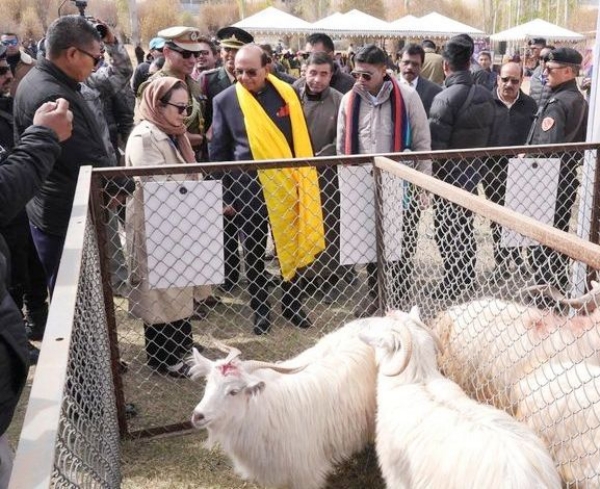
Leh, 23 October (H.S.): Lieutenant Governor Vinai Kumar Saxena today inaugurated the two-day Ladakh Pashmina Conclave: Reverse Buyer-Seller Meet in Leh, bringing together stakeholders from across the Pashmina value chain – from nomadic Pashmina herders and artisans to entrepreneurs, industry representatives, designers, and buyers. The conclave aims to take the ‘Golden Fibre of Ladakh’ to the global stage. Delegates from Mongolia, Japan, and Thailand also participated in the event, opening avenues for international cooperation, knowledge exchange, and stronger market linkages for Ladakh’s distinctive natural fibre.
On the occasion, a Memorandum of Understanding (MoU) was signed between the Ministry of Textiles, Government of India, and the Department of Industries and Commerce, UT Ladakh, to strengthen cooperation for the promotion and development of the Pashmina sector. The Lieutenant Governor also released a postal stamp on GI-tagged Ladakh Pashmina, recognising the unique identity, traditional craftsmanship, and cultural heritage associated with this precious fibre.
A key component of the conclave, the Reverse Buyer-Seller Meet, aims to bring Pashmina producers and enterprises closer to buyers, textile manufacturers, designers, and other market stakeholders. The platform will facilitate direct interactions, help producers understand market requirements, showcase local products, and explore business opportunities and potential commercial partnerships. Direct engagement with buyers can help reduce dependence on multiple intermediaries and provide a greater understanding of quality, grading, processing, and traceability standards required in domestic and international markets.
Lieutenant Governor Saxena said that the recognition of Ladakh Pashmina must translate into tangible economic benefits for those who produce it. “Our vision is clear: Pashmina must be produced in Ladakh, processed in Ladakh, branded as Ladakh Pashmina, and taken to the world from Ladakh,” he said, underscoring the need to strengthen local value addition and ensure that the benefits reach Changpa herders, artisans, women-led self-help groups, and young entrepreneurs.
The Lieutenant Governor highlighted that, alongside promoting scientific breeding, improved shearing and combing practices, cleaner fibre collection, and sustainable pasture management, the Administration is working to increase the Pashmina goat population from approximately two lakh to four lakh within three years.
The participation of delegates from Mongolia, Japan, and Thailand added an international dimension to the conclave. Their presence provided opportunities to exchange experiences and explore cooperation in traditional pastoral livelihoods, fibre quality, processing, craftsmanship, product design, and access to international markets.
The Lieutenant Governor urged delegates from Mongolia to facilitate exchanges of herders, technicians, and researchers between Changthang and the Mongolian steppe to share knowledge and strengthen traditional pastoral practices. He invited Japanese partners to collaborate with Ladakh in precision spinning and finishing, quality certification, traceability, design partnerships with Japanese brands, and establishing direct links with buyers in Japan. Emphasising the scope for international cooperation, he said, “We are not competitors. We are partners in the story of fine natural fibre.”
---------------
Hindusthan Samachar / Krishan Kumar

18 Aug 2026
ED raids KPSC office, 20 other locations over Karnatak veterinary recruitment scam
ED raids KPSC office, 20 other locations over Karnatak veterinary recruitment scam..