




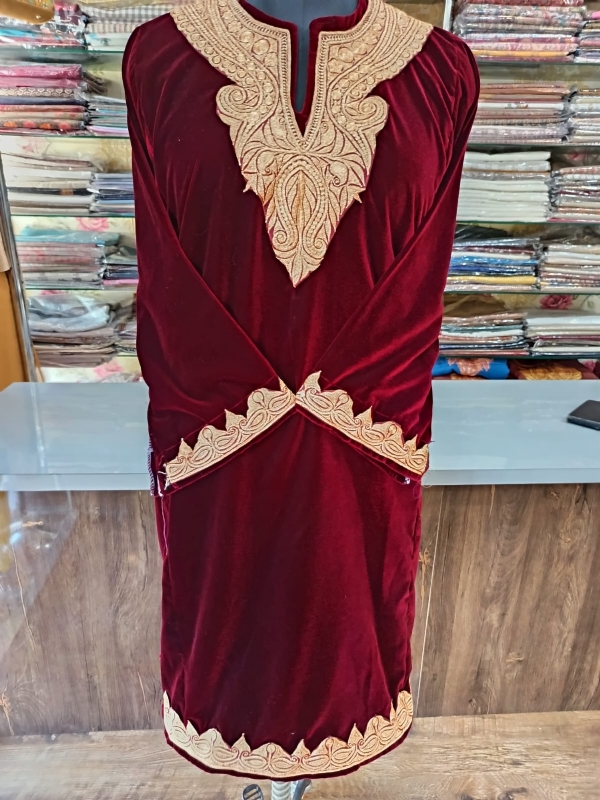
Srinagar, Oct 23 (HS): As winter approaches, people in the Kashmir valley have begun buying the traditional ‘pheran’, and demand for the garment is also rising in other parts of the country, particularly in North India.
The pheran is a loose, long gown worn in Kashmir to ward off the winter cold. It is no longer confined to the Valley. Its distinctive design and comfort have won it a place across the country and abroad, and demand for it is growing by the day.
Historian and poet Zareef Ahmad Zareef describes the pheran as much more than a garment, calling it an important part of Kashmir’s rich culture.
Kashmiri fashion designer Mufti Sadia, who is credited with taking the pheran to countries like the United States, said a garment once worn only in the Valley has now been introduced to the world and is in steadily growing demand.
Speaking to Hindusthan Samachar, she said the pheran is becoming increasingly popular in North India. According to her, it is not worn merely as a fashion statement. Besides being attractive, it is a comfortable garment, which is why people prefer it.
“Once a person starts wearing a pheran, she or he becomes a regular buyer, and their friends and acquaintances buy it too. That is why I keep getting orders for pherans in different designs from across the country and abroad,” she said.
Sadia, who owns ‘Hangers: The Closet’ in Srinagar, said the pheran is also lighter than other long garments such as coats, which is another reason people choose it. She said it is more comfortable than a coat and more elegant, and that it enhances the wearer’s personality.
Mohammad Yaseen Pandit, who runs a Kashmiri art store called ‘Kashmir Expo’ in the Rajouri Garden area of New Delhi, said social media has played a key role in the pheran’s global fame. He told Hindusthan Samachar that some actors wearing it in television serials had also added to its popularity.
However, he expressed concern that machine-made pherans have somewhat dented the reputation of the handmade garment. Machine-made pherans are cheaper than handmade ones, he said, but demand for the handmade pheran remains steady.
The shopkeeper said demand for the pheran has not fallen despite the wide availability of other kinds of warm clothing. “I have been in this business for 25 years. I have seen that, despite the availability of different kinds of warm clothing, demand for it has only increased. There has been no decline,” he said.
“Like Kashmir’s beautiful culture, the pheran is also a beautiful garment. Whoever wears it once makes it an important part of his wardrobe. People wear it irrespective of religion or community,” he added.
Yawar Ali Baba, who runs ‘Baba Art Gallery’ in central Budgam district, said the Kashmiri ‘tilla pheran’ is a special type of pheran worn here and is an essential part of a bride’s attire.
He told Hindusthan Samachar that machine-made tilla pherans, which are somewhat cheaper, are also available in shops, but most people still buy the handmade ones. According to him, a tilla pheran costs at least Rs 15,000, and demand rises as the wedding season begins in Kashmir.
In a detailed conversation with Hindusthan Samachar, Zareef Ahmad Zareef said: “Our traditional dress, the pheran, is not just our clothing but an important part of our rich culture. Over time, it has gone through various stages and adopted different designs, and it is now popular not only in Kashmir but in several foreign countries as well. In Kashmir, it is no longer worn only at home. Officers and other employees now go to office in pherans of new designs.”
Giving a brief history of the garment, he said: “In Kashmir, the pheran is worn according to the weather. In winter, when the cold is at its peak, it was made of a warm fabric known in the local language as ‘poat’ or ‘munel’, while in summer a cotton pheran was worn. With the passage of time, different kinds of warm fabrics began arriving here from various parts of the country, and pherans began to be made from them. Kashmir is also called ‘Iran-e-Saghir’ (Little Iran), so whatever came from Iran, whether clothing or food, was accepted here. The people who came here, such as preachers, traders and artisans, wore a loose garment, called ‘pairaband’ in the Tajik language and ‘pairahan’ in Persian, which was open at the front. Kashmiris made a small modification to suit the weather and began using it. That same pairahan became known in Kashmir as the pheran.”
The historian said people from all religious and social groups in Kashmir wear the pheran, with minor variations, to protect themselves from the biting winter cold.
“Members of the Pandit community used to keep the left sleeve of their pheran somewhat longer, which they used as a muffler in severe cold and on which they would also place a cup of tea. Their pherans have pockets on both sides, while those of others have only one pocket, on the right,” he said.
“The pheran is no longer limited to the Kashmir valley. Its new designs, made to suit fashion trends, have crossed borders and reached several countries, where they are worn with great enthusiasm. That is how the pheran has gained global fame,” he added.
---------------
Hindusthan Samachar / Zahoor Hussain Bhat