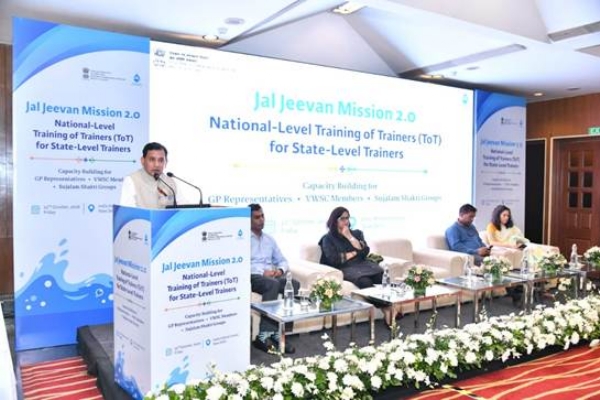
New Delhi, 23 October (H.S.): The Department of Drinking Water and Sanitation under the Ministry of Jal Shakti on Friday organised a national-level Training of Trainers programme in New Delhi to strengthen community-led management and long-term sustainability of rural drinking water supply systems under Jal Jeevan Mission (JJM) 2.0.
Held at the India Habitat Centre, the programme brought together representatives from State Institutes of Rural Development, Public Health Engineering Departments, rural development institutions and other stakeholders to strengthen training and institutional capacity across States and Union Territories.
The programme introduced an eight-module capacity-building package comprising The Story of Panipur: A Story-Based Self-learning Handbook on Rural Drinking Water Supply Management and a Trainer's Facilitation Manual. The material is designed to equip Gram Panchayat representatives, Village Water and Sanitation Committees, Sujalam Shakti Groups and other village-level institutions to manage and maintain rural water supply systems.
Kamal Kishore Soan, Additional Secretary and Mission Director of the National Jal Jeevan Mission, said the long-term sustainability of drinking water infrastructure depended on community ownership and the effective functioning of local institutions. He stressed that Gram Panchayats and village-level committees must take responsibility for protecting and maintaining water supply assets.
He also called for integrating drinking water priorities into Gram Panchayat Development Plans and aligning them with Panchayati Raj institutions, the Rashtriya Gram Swaraj Abhiyan and available finance commission grants. He highlighted the importance of water-source protection, user-charge collection, financial sustainability and community monitoring.
Soan urged States to incorporate the new training modules into existing rural development and Panchayati Raj training systems to ensure continued capacity-building beyond the Mission period.
Swati Meena Naik, Joint Secretary in the Department of Drinking Water and Sanitation, said the sustainability of rural water infrastructure depended on informed communities and capable local institutions. She said the training package uses storytelling, folk communication, role-play, community interaction and gamification to explain technical concepts in a simple and practical manner.
She noted that nearly 54 lakh stakeholders are proposed to be covered under the broader training programme and called on States and Union Territories to establish effective systems for disseminating the material and conducting training.
Naik also highlighted the role of digital platforms, including Sujalam Bharat and programme dashboards, in improving transparency, accountability and public participation in rural water governance. She said Sujalam Shakti Groups could create opportunities for women's leadership and community mobilisation.
The eight-module package uses the fictional village of Panipur to explain village water supply systems, source sustainability, water quality, institutional responsibilities, operation and maintenance, digital governance, community ownership and the development of sustainable Sujal Gaons.
Representatives of UNICEF and UNOPS shared field experiences and approaches to preparing trainers and conducting grassroots-level training in coordination with State Institutes of Rural Development. They also offered support to state public health engineering and rural water supply departments in conducting state- and district-level programmes.
The initiative seeks to build a network of trained state-level resource persons and strengthen the capacity of village institutions to manage drinking water services, address local challenges and maintain infrastructure over the long term.
---------------
Hindusthan Samachar / Indrani Sarkar

18 Aug 2026