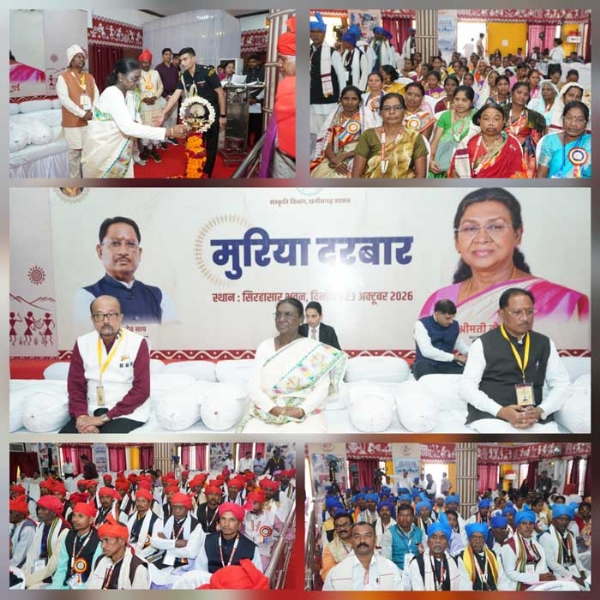
Jagdalpur, 23 October (H.S.): President Droupadi Murmu on Friday described the historic Muria Darbar, an integral part of Bastar Dussehra in Chhattisgarh, as a cultural and historical legacy embodying democratic values. She said the centuries-old tradition, which dates back to the princely era, had served as a forum for dialogue between rulers and the people. Today, it continues to provide an important platform for interaction among local communities, traditional tribal leaders and public representatives.
Addressing the gathering at the historic Muria Darbar in Bastar district, the President described it as an indigenous people's assembly that symbolises collective decision-making and the enduring identity of tribal communities. She said such cultural gatherings offered an opportunity to experience India's rich heritage and understand the traditions that have shaped its diverse communities.
President Murmu is the first President of India to attend the historic Muria Darbar, held as part of the centuries-old Bastar Dussehra celebrations.
Upon arriving in Jagdalpur during her visit to Bastar on Friday, the President first offered prayers at the revered Maa Danteshwari Temple and prayed for the country's prosperity and well-being. She subsequently attended the Muria Darbar, where she interacted with members of its traditional leadership, including Manjhis and Chalkis, as well as other representatives of tribal communities.
Recalling her own roots with pride, President Murmu said she belonged to the same tribal cultural tradition. “I, too, come from this tribal culture. My grandfather, father and brother used to serve as Manjhis. I am the daughter of a Manjhi, and I have a thorough understanding of tribal traditions,” she said.
Highlighting the historical significance of Bastar's tribal customs, she said the Muria Darbar represented a valuable cultural inheritance rooted in democratic principles. Referring to the region's history, she observed that systems of governance had evolved over time—from princely rule to British colonial administration and, subsequently, to democracy. Although laws and administrative structures had changed, she said, the tribal community's traditional systems of self-governance had remained deeply rooted.
She noted that these traditions encouraged people to live in peace, maintain brotherhood and celebrate festivals together.
Speaking about the tribal way of life, the President said that peace, harmony and happiness were central to the community's social ethos. She described its customs as meaningful and enduring, pointing out that traditional village leaders, including Manjhis and Parganas, continued to convene meetings to resolve local disputes and address community concerns.
She observed that people increasingly approached police stations and courts over relatively minor disputes, often prolonging the resolution process and imposing financial burdens on those involved.
Urging people to preserve and strengthen traditional mechanisms of dispute resolution, President Murmu called upon them to respect the Muria Darbar and make constructive use of community-based institutions. She emphasised that many problems could be resolved within villages through mutual understanding, dialogue and trust, rather than allowing disagreements to escalate into prolonged legal disputes.
Referring to the traditional administrative structure, she explained how the system extended from the village panchayat to the Pargana, Pit Pargana and Desh Pargana levels, helping maintain social cohesion. She stressed the need to preserve this longstanding tradition and pass it on to future generations.
The President also referred to the historical struggles of tribal communities for their rights and identity, noting that such struggles had continued even during British rule. She said contemporary social challenges, too, should be addressed through dialogue and collective efforts. Emphasising the importance of unity and cooperation, she invoked the familiar sentiment that an individual may grow weary when carrying a burden alone, but people can overcome difficulties by sharing the load.
Concluding her address, President Murmu underlined two key priorities for the community's continued progress. She urged people to ensure that the historic Muria Darbar tradition never came to an end and remained an enduring part of Bastar's cultural heritage. She also emphasised the importance of education, encouraging families to educate their children and help them advance in life, describing education as the key to a brighter future.
Assuring the gathering of the government's support, she urged the community to preserve its identity, cultural heritage, prosperity and spirit of brotherhood.
## Historian Rudranarayan Panigrahi Briefs President on Bastar Dussehra Traditions
During President Murmu's visit to Bastar, regional historian Rudranarayan Panigrahi briefed her on the historical, religious and cultural traditions associated with Bastar Dussehra. Panigrahi, who has authored several books on Bastar's art and culture, is also associated with theatre.
He informed the President that Maa Danteshwari is the presiding deity of the Bastar region and is revered deeply by its people. Worship of the goddess occupies a significant place in the area's religious practices and cultural traditions. He also explained the centuries-old customs associated with Bastar Dussehra and their importance in shaping the region's social and cultural life.
After learning about Bastar's distinctive cultural heritage and tribal traditions, the President attended the Muria Darbar, where she also interacted with members of the Dussehra committee.
Bastar Dussehra holds a distinctive place among India's cultural celebrations because of its unique religious beliefs, indigenous traditions and historical legacy. Its customs remain closely intertwined with the region's identity and the everyday lives of its people.
---------------
Hindusthan Samachar / Jun Sarkar
18 Aug 2026