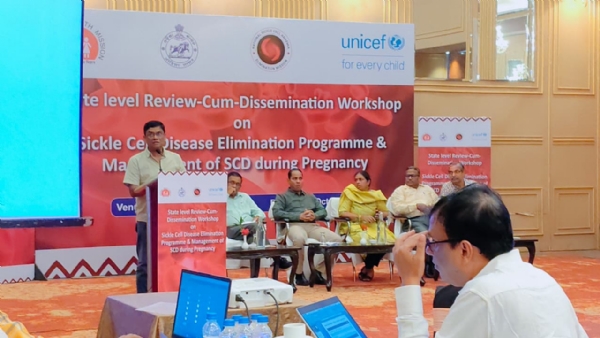
Bhubaneswar, 22 October (H.S.): Odisha has become the first state in India to introduce a dedicated protocol for the management of pregnant women with Sickle Cell Disease, marking a significant step towards reducing maternal health risks associated with the condition.
A one-day State-Level Review-cum-Dissemination Workshop on “Sickle Cell Disease During Pregnancy” was held at Hotel HHI in Bhubaneswar on Thursday. The workshop was jointly organised by the National Health Mission (NHM), Odisha, the Directorate of Blood Safety and UNICEF Odisha.
The workshop aimed to review the implementation of the Sickle Cell Anaemia Elimination Programme and strengthen its delivery across the state. District Public Health Officers (DPHOs) and Assistant Managers (NCD) from 21 high-burden districts participated, along with officials and consultants from NHM and development partners, including the William J Clinton Foundation (WJCF).
Odisha has been at the forefront of screening and detecting Sickle Cell Disease. As part of its efforts to improve maternal health outcomes, the state has formulated a comprehensive Protocol for Management of Pregnancy with Sickle Cell Disease. The protocol was developed collaboratively by experts from state medical colleges, NHM programme divisions, the Health Directorate and UNICEF.
Sickle Cell Disease can pose significant health risks during pregnancy compared with pregnancies unaffected by the condition. Timely diagnosis, systematic monitoring and appropriate medical interventions can help mitigate these risks. The newly introduced protocol provides clinical guidance and defines the responsibilities of healthcare providers at different levels of the health system.
The workshop was inaugurated by Harish Chandra Nayak, Mission Director (In-charge), NHM Odisha; Dr Sanjay Kumar Mohapatra, Director, Blood Safety and Public Health; Dr Bishnu Prasad Mohapatra, Director, Family Welfare; Dr Bijay Kumar Mohapatra, Team Lead, State Health Systems Resource Centre (SHSRC); Dr Murlidhar Padhi, Additional Director, Maternal Health; and Meena Som, Health Specialist, UNICEF Odisha.
During the technical sessions, participants reviewed the current status of the Sickle Cell programme and discussed measures to improve screening, treatment and follow-up services. They also deliberated on transportation benefits, initiatives planned for the current year and the effective implementation of the newly introduced protocol.
The sessions included detailed orientation on the protocol to familiarise healthcare officials with the recommended clinical procedures and their respective responsibilities in managing pregnancies complicated by Sickle Cell Disease.
The workshop concluded with the formulation of a joint action plan to ensure effective and coordinated implementation of the protocol at the district level. The initiative is expected to strengthen healthcare delivery for pregnant women affected by Sickle Cell Disease and support efforts to improve maternal health outcomes across Odisha.
---------------
Hindusthan Samachar / Monalisa Panda

18 Aug 2026
ED raids KPSC office, 20 other locations over Karnatak veterinary recruitment scam
ED raids KPSC office, 20 other locations over Karnatak veterinary recruitment scam..