New Delhi, October 22 (H.S.): India and Poland have agreed to work towards doubling their bilateral trade by 2030, while expanding cooperation in critical minerals, defence, space, nuclear energy and other strategic sectors. Poland will also join India’s Coalition for Disaster Resilient Infrastructure (CDRI) initiative, while the two countries will establish defence industry and counter-terrorism dialogues.
According to the Ministry of External Affairs (MEA), doubling bilateral trade is expected to create employment opportunities, encourage investment and entrepreneurship, and strengthen economic growth in both countries. The proposed defence dialogue will promote collaboration between industries in the two countries, facilitate the exploration of joint development and co-production opportunities, encourage research and innovation, and reinforce defence supply chains.
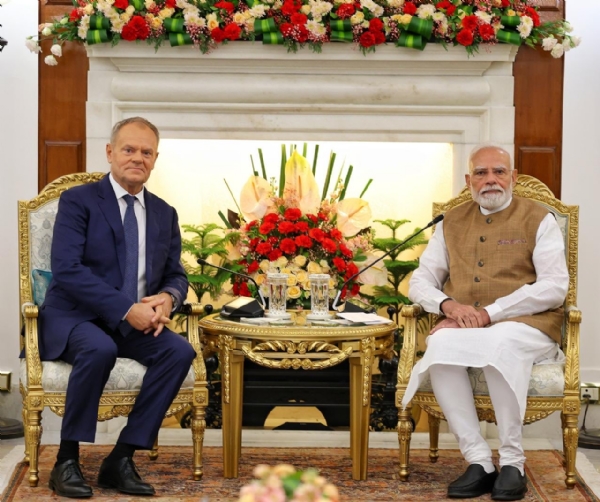
Prime Minister Narendra Modi and his Polish counterpart, Donald Tusk, held delegation-level talks at Hyderabad House in New Delhi on Thursday. A spokesperson for the Ministry of External Affairs described the discussions as marking a new phase in the India-Poland strategic partnership.
Building on the strategic partnership established in 2024, the two leaders explored new avenues of cooperation in artificial intelligence, green technologies, critical minerals and defence. They also discussed strengthening bilateral ties through trade, investment, education, culture and people-to-people exchanges.
Both leaders agreed to work towards doubling bilateral trade by 2030 and underscored the importance of the India-European Union Free Trade Agreement (FTA). They also exchanged views on regional and global developments, reaffirming their commitment to reforming international institutions, including the United Nations Security Council (UNSC), and upholding a rules-based international order.
During a special briefing on the Polish Prime Minister’s visit, MEA Secretary (West) Sibi George said India and Poland had set a target of doubling bilateral trade by 2030. Bilateral trade between the two countries currently stands at approximately USD 6.3 billion, while Indian investments in Poland are estimated to exceed USD 3 billion.
The two countries are also exploring opportunities to expand cooperation in electric vehicle batteries, renewable energy and advanced manufacturing, among other sectors.
George said both sides were working towards finalising agreements relating to the protection of classified information, critical minerals, archives, culture, science and higher education. Prime Minister Modi invited Polish companies to take advantage of the opportunities offered by India’s Make in India initiative.
The two leaders condemned terrorism in all its forms and emphasised the importance of international cooperation in combating the threat. Poland also reiterated its support for India’s permanent membership of a reformed and expanded United Nations Security Council.
Prime Minister Modi said India and Poland had agreed to deepen cooperation in strategic sectors, including defence, space and nuclear energy. He invited Polish companies to partner with India in joint development and co-production initiatives in these fields.
Referring to the situations in Ukraine and West Asia, Modi said India would continue to support every meaningful effort aimed at advancing peace.
The Prime Minister emphasised that India-Poland relations extended beyond diplomatic engagement and were rooted in a shared legacy of humanity and compassion. During the Second World War, the royal families of Jamnagar and Kolhapur had provided refuge in India to thousands of Polish children and families.
He described cultural ties and people-to-people exchanges as among the strongest pillars of the bilateral relationship. Modi also highlighted Poland’s rich traditions of Sanskrit studies and Indology, noting that the establishment of a chair for Indian studies in Krakow represented another effort to deepen the countries’ cultural connections.
Polish Prime Minister Donald Tusk, meanwhile, stressed the importance of expanding cooperation with India in critical minerals, strategic resources, defence and space. He said both countries needed to strengthen their self-reliance in these areas.
Speaking after his talks with Modi, Tusk said economic relations formed the foundation of the India-Poland strategic partnership. Representatives of companies from both countries were also part of the respective delegations, reflecting the importance attached to commercial cooperation.
Tusk said India and Poland shared ambitious objectives in sectors such as mining, gas, shipbuilding, satellites, digital technology and drones. He also expressed hope for greater mutual cooperation on multilateral platforms, including the G20.
---------------
Hindusthan Samachar / Jun Sarkar

18 Aug 2026