




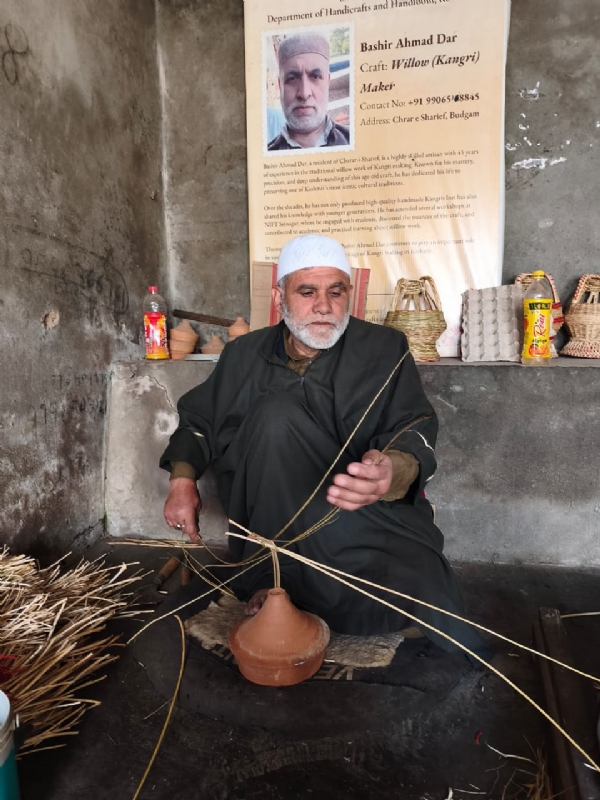
Charar-i-Sharief, Oct
21 (HS): People in the Kashmir
valley have relied on the traditional kangri to fend off the bitter cold of
winter since time immemorial. Despite the availability of modern heating
appliances, the kangri continues to hold sway.
With the onset of autumn
to be followed by bitter winter, kangris have begun appearing in shops across
towns and villages. They are not only a means of combating the harsh cold but
also an integral part of Kashmir’s rich culture.
Kangris are made in
various parts of the valley, but those crafted in Charar-i-Sharief in central
Kashmir are known for their distinctive design and fine craftsmanship. The town
is renowned worldwide as the abode of Alamdar-e-Kashmir Hazrat Sheikh
Noor-ud-Din Noorani (RA).
A kangri is an earthen
pot encased in a wicker basket woven from willow twigs. It is filled with
burning embers and carried under the traditional gown, the pheran, to keep the
body warm.
Modern heating devices
have affected its use and trade to some extent, yet the kangri remains a
fixture in almost every Kashmiri home.
Ghulam Hassan Khadim, a
well-known kangri maker from Charar-i-Sharief, said the town’s kangris enjoy a
special association with Alamdar-e-Kashmir, which has made them popular across
the valley and in several parts of the country.
Speaking to Hindusthan
Samachar, he said: “The biggest hallmark of the Charar-i-Sharief kangri is its
association with Alamdar-e-Kashmir. Devotees of the saint also buy it as a
keepsake of blessing (tabarruk).”
He added that the kangri
is also distinctive in its structure and finish. Most people in the valley
start buying kangris as early as autumn, he said, and customers have begun
thronging his workshop.
Asked about the impact of
modern heating appliances on the trade, Khadim said he remains content with his
work despite a decline in demand.
“My family has been
associated with this craft for 70 years, and I have been doing this work for 40
years to support my family. It is from this trade that I educated my children.
I am satisfied with this work despite the fall in demand,” he said.
However, he expressed
regret that the younger generation is not taking up the craft. “The new
generation does not learn this work. They prefer other jobs to earn a
livelihood. One reason is that they lack the patience this work demands, and
the earnings are also not high,” he said.
Khadim said Kashmiri
Pandits used to buy special kangris for the Herath festival, but the trade
suffered after their migration from the valley.
“Pandits used to buy
special kangris during Herath and send them as gifts to their daughters. That
practice came to an end after their migration, which adversely affected the
business,” he said.
Given the fall in demand,
artisans now make kangris in a variety of designs that serve not only as
heating devices but also as home décor, he said.
A special kangri
presented to a bride at weddings costs between Rs 10,000 and Rs 12,000, Khadim
said. Such pieces take more time and material to make, but also fetch good
returns, he added.
Ordinary kangris used for
warmth come in different varieties and are priced accordingly. “Kangris used
for everyday warmth are relatively simple and cheaper, costing between Rs 250
and Rs 300, while better ones priced between Rs 800 and Rs 1,200 are bought by
the well-off,” he said.
Khadim said thousands of
people still depend on the industry. “Thousands of people, from kangri makers
to traders, earn their livelihood from this business. Some material for the
special kangris comes from Delhi, while hundreds of people here, from potters
to willow-twig sellers, support their families through this trade,” he said.
On the government’s
efforts to promote the industry, Khadim said it has been paying serious
attention to the sector for the past two to three years, with concrete steps
being taken for its promotion.
“The Handicrafts
Department honours artisans with awards to encourage them and also provides
subsidised bank loans to needy craftsmen,” he said.
He said that with
sustained attention from the government and the public, the industry could
become a major and effective source of employment for unemployed youth in the
valley.
---------------
Hindusthan Samachar / Zahoor Hussain Bhat