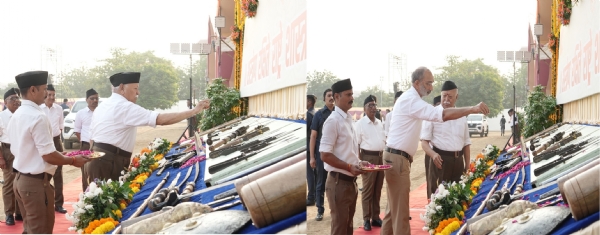
Nagpur, 20 October (H.S.) : The Rashtriya Swayamsevak Sangh (RSS) held its annual Vijayadashami celebration at its Reshimbagh headquarters in Nagpur, featuring the traditional Shastra Pujan, a disciplined march by swayamsevaks and a pledge to build the nation. Sarsanghchalak Dr Mohan Bhagwat performed the traditional Shastra Pujan to the chanting of mantras and offered floral tributes at the samadhi of Sangh founder Dr Keshav Baliram Hedgewar. Dainik Jagran Editor-in-Chief Sanjay Gupta attended the ceremony, held in the 101st year of the Sangh’s founding, as chief guest. The presence of Jagdeep Dhankhar, former Vice-President, and Yaniv Revach, Consul General of Israel in Mumbai, also gave the event a distinctive profile. The focus of the gathering was the direction the Sangh will take after its centenary journey, and its commitment to social organisation and nation-building.
Shastra Pujan opens proceedings; tribute to Hedgewar
The ceremony at Reshimbagh began in keeping with Sangh traditions. Dr Bhagwat, who arrived in full ganvesh, performed the Shastra Pujan with due ritual and the chanting of mantras. The observance, held every Vijayadashami, occupies a special place in the Sangh’s organisational tradition. He then paid floral tribute at the samadhi of the Sangh’s founder, Dr Keshav Baliram Hedgewar.
Chief guest Sanjay Gupta also offered flowers at Dr Hedgewar’s samadhi. The Sarsanghchalak then took to the stage to deliver the annual Vijayadashami address. At this yearly event of the Sangh, the Sarsanghchalak’s address is regarded as significant for what it signals about the organisation’s priorities, the social challenges it sees and its future course of action.
A journey begun in 1925; the Sangh in its 101st year
Dr Keshav Baliram Hedgewar founded the Rashtriya Swayamsevak Sangh on Vijayadashami in 1925. The organisation’s journey, which began in Nagpur, has now entered its 101st year. Over this period, the Sangh has expanded through shakhas, training, social service and the participation of swayamsevaks in a range of fields.
In the Sangh’s worldview, individual-building is the foundation of broader change in society and the nation. Discipline, character-building, social cohesion and cultural consciousness have been its principal ideological pillars. Swayamsevaks associated with the organisation take part in a variety of social, educational and service activities.
In accounts of the Sangh’s history, its relief work during Partition, its activities during the Goa liberation movement and its opposition to the Emergency are prominently cited. With these episodes, the organisation has consistently underlined its record of national service and its social role.
Sanjay Gupta’s presence adds weight to the occasion
At this year’s ceremony, Dainik Jagran Editor-in-Chief Sanjay Gupta attended as chief guest. His presence gave the event a prominent link with the world of the media. The attendance of Jagdeep Dhankhar, former Vice-President, was also notable.
Yaniv Revach, Consul General of Israel in Mumbai, also took part. His presence added an element of international representation to the event. However, drawing any specific diplomatic or strategic conclusion from his attendance would require official comment from the parties concerned.
Discipline on display in Pradakshina Sanchalan
After the Shastra Pujan, the swayamsevaks carried out the Pradakshina Sanchalan on the Reshimbagh grounds. Lined up in full ganvesh, they marched in step along a fixed route to the music of the band. Collective discipline, uniformity and organisational training were the hallmarks of the display.
The Vijayadashami event holds special significance in the Sangh’s traditions. While the Shastra Pujan is seen as a symbol of strength and duty, the collective march showcases the training of swayamsevaks and the Sangh’s organisational coordination.
Looking ahead after the centenary
Coming after the Sangh completed 100 years, this event in its 101st year is also significant for what it may reveal about the organisation’s future priorities. Themes such as social harmony, civic duty, service activities, cultural consciousness and nation-building have long figured prominently in the Sangh’s public ideology.
Amid the goal of Viksit Bharat and the wider national aspiration to make India a developed nation by 2047, attention is also turning to the Sangh’s role, social participation and the contribution of its swayamsevaks. The challenge ahead for the Sangh is to carry dialogue and service activities to different sections of society as it continues to expand organisationally.
The Vijayadashami celebration at Reshimbagh in Nagpur once again brought the Sangh’s traditions, discipline and organisational identity to the fore. Political, social and ideological circles across the country are now watching the Sarsanghchalak’s address and the organisation’s forthcoming priorities. Indeed, following the ceremony, Dr Bhagwat delivered his main address, and everyone is now reflecting closely on its conclusions.
---------------
Hindusthan Samachar / Mayank Chaturvedi
18 Aug 2026