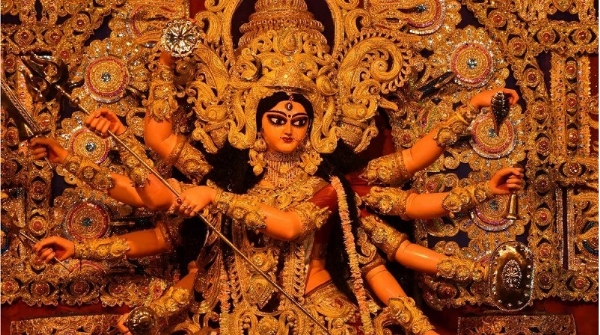
Dhubri (Assam), 20 October (HS): A unique Durga Puja tradition continues at a temple situated amid barbed-wire fencing along the India-Bangladesh border in Assam’s Dhubri district, where devotees are allowed to offer prayers only once a year on the occasion of Maha Navami.
Located in the Golakganj area, the Mahamaya and Kali temple draws a large number of devotees every year on Navami. The annual worship takes place under the strict supervision of the Border Security Force (BSF), which regulates access to the religious site due to its sensitive location along the international border.
According to local accounts, the tradition of worship at the temple dates back to the period before British rule in India. The subsequent Partition and the creation of Bangladesh led to the demarcation of the international boundary, making access to the temple difficult for ordinary devotees. However, the centuries-old religious practice has continued despite the restrictions.
The temple is situated near Border Pillar No. 1001 in Bhoggarhi village of the Satrashal area, close to the India-Bangladesh border. Local residents say people from different communities had been visiting the shrine for worship long before the boundary was demarcated.
On Tuesday, devotees gathered at the temple to seek the blessings of Goddess Mahamaya and Goddess Kali. Special permission is granted to the public on Maha Navami to preserve the traditional religious practice, while BSF personnel continue to offer prayers at the shrine throughout the year.
The temple also reflects a tradition of inter-community participation, with people from both Hindu and Muslim communities having visited the religious site over the years. This longstanding association has added to its social and cultural significance in the border region.
People from Bangladesh had also participated in the annual worship in the past. However, their participation has reportedly declined amid the changing political situation following the fall of Sheikh Hasina’s government.
The Mahamaya and Kali temple has thus retained its distinctive identity, combining a long-standing religious tradition with the unique challenges of its location along a heavily guarded international border. The annual access granted to devotees on Maha Navami remains central to keeping the tradition alive.-----------
Hindusthan Samachar / Sriprakash
18 Aug 2026
ED raids KPSC office, 20 other locations over Karnatak veterinary recruitment scam
ED raids KPSC office, 20 other locations over Karnatak veterinary recruitment scam..