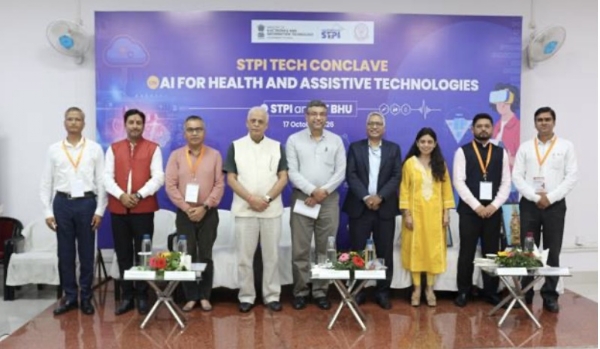
New Delhi, 18 October (H.S.): The need to leverage artificial intelligence (AI) to make healthcare services more accessible, affordable and effective, while developing innovative assistive technologies to support persons with disabilities, was emphasised at a technology conference held on Sunday.
The conference, titled ‘AI for Healthcare and Assistive Technologies’, was jointly organised by the Software Technology Parks of India (STPI) and the Innovation, Incubation and Entrepreneurship Centre of the Indian Institute of Technology (Banaras Hindu University). Government representatives, academicians, healthcare professionals and startup representatives participated in the event to discuss the potential of AI in transforming healthcare delivery and advancing assistive technology.
S. Krishnan, Secretary in the Ministry of Electronics and Information Technology, said AI could play a significant role in expanding access to healthcare services and improving clinical decision-making. He highlighted its potential applications in the early detection of diseases, medical diagnostics, remote monitoring of intensive care units and surgical planning. He also stressed the importance of strengthening collaboration among research institutions, medical sciences and the technology sector to accelerate innovation in healthcare.
STPI Director General Arvind Kumar underscored the need to promote indigenous innovation, entrepreneurship and research, and to translate scientific advances into practical products. He said startups offered young people opportunities not only to secure employment but also to become job creators.
IIT (BHU) Director Amit Patra emphasised the importance of helping students and researchers transform their ideas into startups and connecting them with financial support to facilitate the development and commercialisation of innovative solutions.
Two panel discussions were held during the conference, focusing on AI-enabled healthcare services, inclusivity and assistive technologies. Experts highlighted the need for stronger collaboration among the government, academic institutions, healthcare sector and startups to convert research into practical solutions that can be deployed at scale.
The discussions underlined the potential of AI-driven innovation to improve healthcare access and quality while advancing the development of technologies that can enhance independence and support the needs of persons with disabilities.
---------------
Hindusthan Samachar / Jun Sarkar

18 Aug 2026