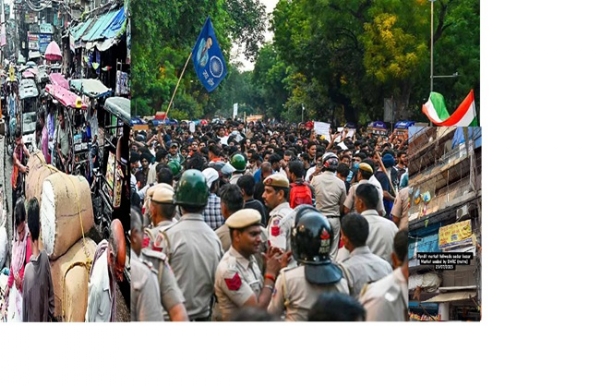
New Delhi, 18 October (H.S.): Protests across the national capital have caused traders an estimated loss of Rs 4,000 crore over the past 10 days, Praveen Khandelwal, national secretary-general of the Confederation of All India Traders (CAIT) and a Member of Parliament, said on Sunday.
Expressing deep concern over the adverse impact of the ongoing demonstrations on commercial activities in New Delhi, Khandelwal warned that if disruptions in the markets continued for an extended period, daily business worth more than Rs 400 crore could be affected.
Khandelwal said Delhi records average daily commercial transactions of approximately Rs 2,200 crore, making its extensive trading network particularly vulnerable to disruptions. He estimated that the cumulative business losses over a 10-day period could reach a substantial Rs 4,000 crore.
Referring to constitutional provisions, Khandelwal said Article 19(1)(a) of the Constitution guarantees citizens the freedom of speech and expression, while Article 19(1)(b) protects their right to assemble peacefully. However, he pointed out that Article 19(1)(g) also guarantees citizens the right to practise any profession or carry on any occupation, trade or business.
He emphasised that the exercise of democratic rights should not infringe upon the legitimate rights of other citizens and business owners. The exercise of one fundamental right, he said, should not jeopardise the livelihoods of others. While the right to peaceful protest must be protected, it should not impose an undue economic burden on the general public, traders and workers.
According to Khandelwal, the impact of protests extends well beyond the immediate locations where demonstrations take place. Prolonged traffic congestion, reduced customer footfall, disruptions in the transportation of goods and shortened business hours affect the entire supply chain.
He said small shopkeepers and street vendors are among those hit hardest by such disruptions. Even when sales come to a standstill, they must continue to pay shop rents, employees’ wages, electricity bills and bank instalments, placing considerable pressure on their finances.
Khandelwal noted that the period from October to January is particularly important for consumer spending across the country, as it coincides with the festive and wedding seasons. Delhi, he added, serves as the largest wholesale and distribution hub in northern India, making the continuity of its commercial activities especially significant.
He appealed to all stakeholders to adopt a balanced approach that safeguards democratic expression while protecting Delhi’s trade and the livelihoods of ordinary people during the crucial festive and wedding season.
---------------
Hindusthan Samachar / Jun Sarkar
18 Aug 2026