




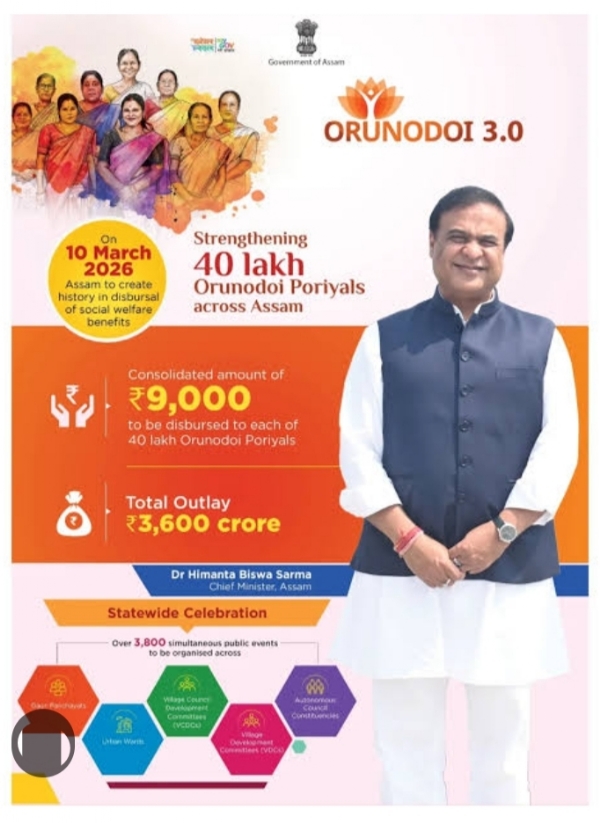
Guwahati, 16 October (HS): For thousands of low-income households in Assam, a monthly financial transfer of 1,250 rupees is more than just government assistance. It is a source of support that can help women manage household expenses, meet essential needs and contribute to their families’ financial security. Through the Orunodoi Yojana, the Assam government is seeking to strengthen the economic position of vulnerable households by placing women at the centre of its welfare delivery system.
Under Orunodoi 3.0, eligible families receive 1,250 rupees every month through Direct Benefit Transfer (DBT). The assistance is deposited directly into the Aadhaar-seeded bank account of the nominated woman beneficiary, reducing the need for intermediaries and enabling beneficiaries to access the money through formal banking channels.
The scheme reflects an approach to welfare in which financial assistance is routed directly to women, recognising their role in managing household budgets and meeting the everyday needs of family members. For households with limited and irregular incomes, even a modest monthly transfer can provide some predictability in managing essential expenditure.
Women at the Centre of Welfare Delivery
A key feature of Orunodoi is the nomination of a woman member as the primary beneficiary of the household. This design places women at the forefront of financial assistance and gives them a direct role in deciding how the money is used to meet family needs.
The assistance can help eligible households manage recurring expenses, including groceries, medicines and other essential requirements. However, the actual impact depends on individual household circumstances, the cost of living and the availability of other sources of income.
The scheme also seeks to extend support to particularly vulnerable sections of society. Priority groups include widows, unmarried or divorced women above 45 years of age, transgender persons, persons with disabilities and families with members suffering from major illnesses such as HIV, thalassaemia and cerebral palsy.
For these households, which may face additional financial pressures because of limited earning opportunities or healthcare requirements, regular assistance can offer an additional layer of economic support.
Targeting the Most Vulnerable
Orunodoi 3.0 is designed to support economically disadvantaged households. Families are required to have an annual composite household income of less than two lakh rupees to qualify under the stated eligibility criteria.
Households with regular government employees or income taxpayers are excluded from the scheme, helping focus assistance on families considered more economically vulnerable.
The direct transfer mechanism is another important element of the programme. By depositing the assistance into an Aadhaar-seeded bank account, the government aims to make the delivery process more direct and transparent. For beneficiaries, access to the money through their own bank accounts also creates a formal channel for receiving welfare support.
Beyond Financial Assistance
The significance of Orunodoi lies not only in the amount transferred each month but also in its focus on women-led household welfare. By directing financial assistance to a woman member, the scheme seeks to give women a more prominent role in household financial management while providing relief to families facing economic constraints.
At the same time, the long-term effectiveness of the programme will depend on factors such as the timely delivery of benefits, accurate identification of eligible households, grievance redressal and the adequacy of the assistance in relation to rising household expenses.
Regular assessments of beneficiary experiences and the use of the transferred funds would help establish the scheme’s actual contribution to poverty alleviation and women's economic empowerment.
Orunodoi 3.0 thus represents an important component of Assam's welfare approach, combining monthly financial assistance with a delivery system that places women at the centre. For eligible low-income families, the programme offers recurring support to meet essential needs, while its broader promise rests on how effectively that support reaches the most vulnerable households.------------
Hindusthan Samachar / Sriprakash