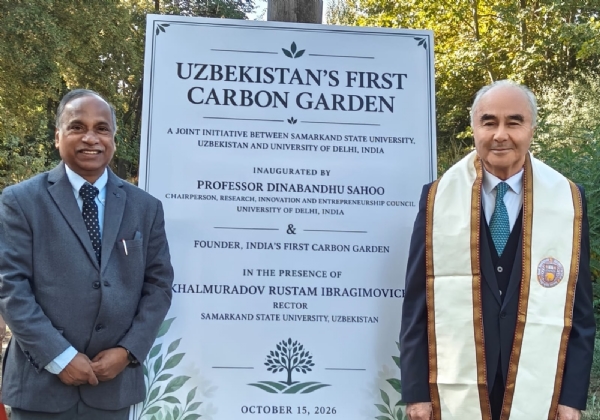
New Delhi, 16 October (H.S.): In a significant initiative to promote scientific and academic cooperation between India and Uzbekistan, an ‘Indian Carbon Garden’ has been established at Samarkand State University in Samarkand, Uzbekistan. Designed and developed by Professor Dinabandhu Sahu of the University of Delhi, the garden was inaugurated by Professor Sahoo, Chairman of the University of Delhi’s Research, Innovation and Entrepreneurship Council and founder of India’s first Carbon Garden.
The inauguration was attended by Professor Rustam Kholmuradov, Rector of Samarkand State University and a Senator of Uzbekistan, along with several senior academics from the university. Those present included the Pro-Vice-Chancellor, directors and heads of various departments.
Addressing the gathering, Professor Kholmuradov said the establishment of the Carbon Garden was significant not only for Uzbekistan but also for the wider Central Asian region, which is particularly vulnerable to the effects of climate change. He noted that initiatives such as Carbon Gardens could play an important role in promoting environmental conservation and raising awareness about biodiversity.
He described the initiative as an important step towards strengthening scientific and academic ties between India and Uzbekistan. He added that the partnership could be expanded by encouraging academic and cultural exchange programmes between the two countries. He also emphasised the need to conserve robust germplasm, or genetic material, in the region and develop repositories of important crops.
Professor Dinabandhu Sahoo said more Carbon Gardens should be established in different countries, particularly across Central Asia, to raise public awareness of their environmental significance.
He explained that Carbon Gardens were not limited to carbon conservation but could also be developed as ecosystem-service models and small biodiversity parks. Such spaces, he said, could serve as effective tools for helping people understand the importance of environmental protection, biodiversity and the benefits provided by ecosystems.
Professor Sahoo noted that Carbon Gardens had already been established at several colleges in India. He said there was considerable scope to expand the initiative to more educational institutions across the country and extend it internationally in the coming years.
Former Pro-Vice-Chancellor of Samarkand State University, Professor Mukhtor Nasirov, expressed his commitment to advancing the initiative. He had recently led a delegation visiting India and said efforts would be made to establish similar Carbon Gardens in other parts of Central Asia.
---------------
Hindusthan Samachar / Jun Sarkar

18 Aug 2026