Prashant Shekhar Mishra
New Delhi, 15 October (H.S.): The Uttar Pradesh government is working to fill vacancies in higher educational institutions, expand digital facilities in rural colleges and make examinations more transparent and free from cheating. In line with the National Education Policy (NEP) 2020, universities and colleges across the state are undergoing changes aimed at modernising the education system. The government has also distributed tablets and smartphones to students, while a scheme to provide scooters to meritorious female students is under consideration.
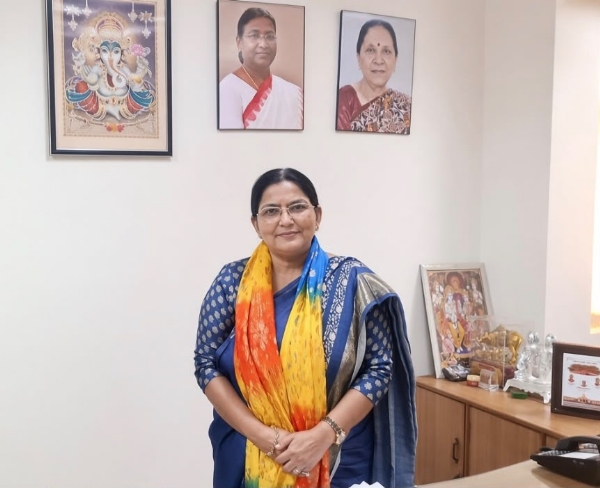
In an interview with 'Hindusthan Samachar', Rajni Tiwari, Uttar Pradesh’s Minister of State for Higher Education and MLA from Shahabad in Hardoi district, discussed the government’s approach to filling vacant posts in higher educational institutions, expanding digital classrooms in rural areas, curbing examination malpractice, accelerating development in the state, women’s reservation and the emerging political landscape.
The following are the major excerpts from the interview.
Q: How do you view your long journey from being a homemaker to becoming a four-time MLA and a minister?
A: It was a period when I entered politics unexpectedly because of the circumstances. However, once I entered public life, I clearly realised that the people had placed tremendous trust in me and that I had to live up to their expectations under all circumstances. I did everything possible for my people and my constituency, serving the public while accelerating development work. I believe I have been successful in honouring the people’s aspirations and the unwavering faith they have placed in me.
Q: What has sustained your electoral success over four consecutive terms?
A: Anyone can enter politics, regardless of their background, but remaining relevant and effective in public life requires sustained hard work and the ability to earn people’s trust. People place their confidence in a representative only when that person stands by them through their joys and hardships. I have always worked among the people. Over the past nearly 20 years, there has hardly been an occasion when I stayed at home for four or five consecutive days. I have remained accessible to the public seven days a week, around the clock. This constant engagement has established an enduring bond of trust: we have faith in our people, and they have faith in us.
Q: What steps is the government taking to fill vacancies in higher educational institutions across Uttar Pradesh?
A: The fundamental objective of the National Education Policy (NEP) 2020 is to connect education with our culture and values, enrich it with modern technology and provide young people with direct employment opportunities. Our entire education system is working on the ground with this vision. Naturally, whenever a new and comprehensive policy is introduced, it takes some time to integrate it into the entire system.
Q: Modern facilities such as digital classrooms and laboratories remain inadequate in rural degree colleges. What has caused this shortfall?
A: Extensive work has been undertaken to strengthen educational institutions in rural areas. Although it is true that the work remains incomplete in some remote rural locations, we have established digital libraries and digital parks in colleges serving rural communities as well. Our objective is to ensure that modern digital technology reaches every student, just as we are working to make education accessible to every child. Shaping the future of young people is our foremost responsibility. The government is continuously increasing budgetary allocations and resources to equip colleges in rural areas with modern facilities.
Q: What is the department doing to ensure the integrity and transparency of examinations and the timely conduct of academic sessions?
A: The state has also witnessed a period when, under previous governments, political leaders would reportedly tell people from public platforms, ‘Vote for us, and we will allow you to cheat in examinations.’ That system pushed the future of young people into darkness. Today, under the leadership of Prime Minister Narendra Modi and Uttar Pradesh Chief Minister Yogi Adityanath, the examination and academic-session systems have undergone fundamental changes. Higher education is being made transparent and free from examination malpractice. Our policies are no longer confined to awarding degrees; they aim to prepare young people to compete at the global level. The system has been made fully accountable to ensure that examinations are conducted properly and academic sessions remain on schedule, enabling Indian youth to demonstrate their abilities on the international stage.
Q: What special measures have been taken to reduce female students’ dropout rates and increase their enrolment in higher education?
A: In the past, girls often had to discontinue their education because of social and economic constraints, but such cases have declined considerably. On the one hand, the state’s law-and-order arrangements have helped girls feel safer; on the other, the government’s welfare schemes have provided them with support. We have distributed tablets and smartphones on a large scale to connect female students with technology. The state government is also working actively on a scheme to provide scooters to meritorious female students.
In addition, state universities and private universities have been established in divisions that previously lacked universities. Women’s degree colleges and government colleges have also been opened locally so that girls do not have to travel long distances to pursue higher education. These initiatives are intended to enable students from rural backgrounds to complete their education without unnecessary obstacles.
Q: What strategy is the department pursuing to increase enrolment in higher education after Class 12?
A: Previously, many children dropped out of the education system at the basic schooling stage. To address this, we launched the ‘School Chalo Abhiyan’ to ensure universal enrolment. We have now established direct coordination among basic, secondary and higher education. The department is closely monitoring cases in which students do not enter higher education after Class 12 or discontinue their studies after the first year or semester, seeking to understand the reasons behind these decisions.
Systemic measures are being introduced to prevent such dropouts. Today, male and female students are advancing in higher education alike, and the government remains committed to continuously improving the quality of education.
Q: How do you assess the role of opposition parties in the debate over women’s reservation?
A: The entire country has witnessed what I consider the opposition’s double standards in Parliament. When the historic Nari Shakti Vandan Adhiniyam, or Women’s Reservation Act, was introduced, opposition parties, in my view, made an objectionable attempt to prevent women from securing appropriate representation in legislative institutions. Opposition leaders publicly portray themselves as champions of women’s interests, but when the time comes to formulate policies and grant women their rights, they stand in opposition.
They speak about women’s interests for the sake of vote-bank politics, but retreat when it comes to taking concrete policy decisions. Women across Uttar Pradesh and the country understand what I regard as the opposition’s opportunistic and contradictory approach.
Q: What is your strategy for countering the Samajwadi Party’s PDA formula?
A: The opposition itself appears confused about its slogans. At times, it says the ‘P’ in PDA stands for *Pichhda* (backward communities); at other times, it interprets it as *Pandit* (Brahmin), or gives it some other meaning. It has no ideology, no clear policy and no vision. Its leaders change their definitions according to the audience and the political circumstances.
The Bharatiya Janata Party (BJP) represents all sections of society and has introduced welfare schemes for their advancement without appeasement. The public is highly aware. You may mislead someone once, but not repeatedly. A trick cannot work indefinitely. In the face of the development initiatives undertaken by Prime Minister Modi and Chief Minister Yogi Adityanath, the opposition has no substantive electoral issue left, in my assessment.
Q: What is the government doing to strengthen women’s representation in both the administration and the party organisation?
A: The Bharatiya Janata Party places the highest importance on respecting and empowering women. Comprehensive social and national development is possible only when women, who constitute half the population, participate actively and equally. Prime Minister Narendra Modi has given women’s empowerment a historic direction by securing a provision for 33 per cent reservation for women in Parliament and state legislative assemblies. At the grassroots level, women are also being helped to become self-reliant through self-help groups and various government schemes.
Q: What are your major development achievements and dream projects for Shahabad?
A: We have prioritised and fulfilled the demands placed before us by the people, whether they concerned rural areas or the town. There is no major promise that we have left unfulfilled. We delivered on the long-standing demand for the Anjhi-Shahabad railway overbridge. Several important connecting roads, including Shahabad-Pihani, Shahabad-Sandi and Pali-Anangpur, have been widened and renovated.
During the COVID-19 pandemic, I ensured the provision of an oxygen plant using my constituency development fund. We also facilitated the construction of a modern roadways bus terminal in the town and secured government funding for the establishment of a Munsif Court. A new community health centre (CHC), primary health centres (PHCs) and a government women’s degree college have also been established in the area.
Our next major commitment is to establish a state-of-the-art engineering college in Shahabad, a project we are determined to realise in the coming period.
Q: How do you respond to concerns about possible anti-incumbency after such a long period in office?
A: I am surprised when people talk about anti-incumbency. Even after nearly two decades in politics, there is no anti-incumbency wave in our constituency. The direct reason is that we live among the people not merely as their elected representative but as a member of their family. We have the strong leadership of Prime Minister Modi at the Centre and the good-governance policies of Chief Minister Yogi Adityanath in Uttar Pradesh. People understand these development policies very well, which is why we face no significant difficulties in the constituency. We work together as one family.
Q: The opposition alleges that rural residents want change at the local level. What is your response?
A: As elections approach, the opposition has little choice but to make baseless allegations. Its leaders know very well what the election results are likely to be. Public confidence in them has eroded, and they have lost political ground. They are already devising excuses to offer the public after a possible defeat. Our party, by contrast, remains firmly committed to development, good governance and public service.
Q: Are there any promises to the constituency that remain unfulfilled and for which you may have to answer in the next election?
A: We have translated all our major promises to the public into action. However, development is a continuous process, and people’s needs never come to an end. Just as we continually improve and organise our homes, we regard the entire assembly constituency as our family. We have undertaken extensive development work, but our commitment to making the area more developed and prosperous will always remain.
The pace of development will not stop. The BJP and I remain firmly committed to the guiding principle of ‘Sabka Saath, Sabka Vikas, Sabka Vishwas and Sabka Prayas’—collective effort, inclusive development, public trust and the participation of all. We have carried out development work without discrimination and moved forward by taking every section of society along with us.
---------------
Hindusthan Samachar / Jun Sarkar
18 Aug 2026