




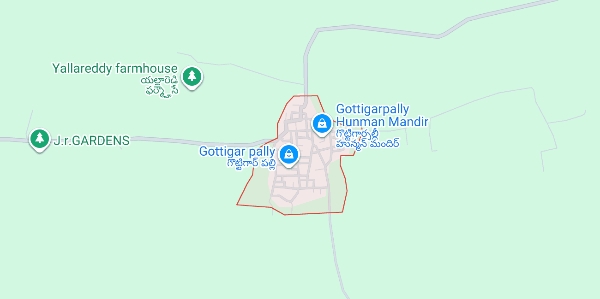
Gottigarpalli (Telangana), 14 October(HS): A water-conservation model developed in Gottigarpalli village in Telangana travelled to Rajasthan, where it was adopted under the Mukhyamantri Jal Swavlamban Abhiyan across 33 districts between 2014 and 2018. Known as the Four Waters Concept, the approach integrates rainwater harvesting, surface-water management, groundwater recharge and soil-moisture conservation. Its adoption in Rajasthan, followed by reported improvements in agricultural activity in districts including Banswara, Jhalawar, Sirohi and Udaipur, has brought renewed attention to the model in Telangana, where a former National Disaster Management Authority vice-chairman called for its wider implementation in October 2026.
Introduced in 2001-02 by irrigation engineer T. Hanumantha Rao, the approach was designed to address a recurring problem in semi-arid agricultural regions: rainwater running off quickly, limited groundwater recharge and inadequate moisture for cultivation between rainfall periods. Gottigarpalli, now in Sangareddy district, became a prominent example of how watershed engineering could improve local water availability and support multiple crops.
The concept was implemented in several villages in the then undivided Andhra Pradesh, including locations in present-day Telangana and the Rayalaseema region. Former NDMA vice-chairman Marri Shashidhar Reddy has said that the approach covered around 84 villages in Telangana and approximately 120 villages in Rayalaseema. Its subsequent adoption in Rajasthan brought the model into a much larger state programme.
Gottigarpalli: The Village That Sustained Multiple Crops
Gottigarpalli's experience is central to the model's reputation. The watershed intervention combined earthen structures and vegetation measures to slow runoff, reduce soil erosion and improve groundwater recharge. The design followed a ridge-to-valley approach, treating the catchment as a connected system rather than concentrating all conservation work around one water body.
Accounts of the project describe the construction of 163 mini percolation tanks and approximately 500 hectares of continuous contour trenches and staggered trenches in the surrounding terrain. The intervention was implemented under the Drought Prone Area Development Programme between 2001 and 2004.
Farmers in the village report growing as many as three crops annually, including sugarcane. Residents have attributed the change to improved local water availability and the ability to retain groundwater for agricultural use.
The village's experience is particularly relevant in semi-arid areas where rainfall can be concentrated within a short period. Capturing runoff and improving infiltration can help sustain agriculture between rainy periods, although results depend on rainfall, soil conditions, groundwater extraction and the maintenance of conservation structures.
The model does not create additional rainfall or guarantee protection against drought. Its purpose is to make more effective use of the water that reaches a watershed.
Rajasthan Takes the Model Across 33 Districts
The Four Waters Concept gained a wider institutional application when Rajasthan incorporated it into the Mukhyamantri Jal Swavlamban Abhiyan between 2014 and 2018. The programme aimed to improve village-level water security by combining conservation structures, catchment treatment, community participation and coordination among government departments.
The scale of the programme was substantial. A Rajasthan government account published in 2018 reported that the first three phases had covered 12,042 villages and created or renovated approximately 3.90 lakh rainwater-harvesting structures. The government also reported an average rise of 4.66 feet in the water table across 21 non-desert districts.
These are programme-level figures and should not be interpreted as outcomes attributable solely to the Four Waters Concept in every village. The programme combined multiple interventions, and results varied according to local conditions.
A March 2025 assessment by watershed experts examined the experience in Banswara, Jhalawar, Sirohi and Udaipur. It reported shifts from single cropping towards double and triple cropping in areas where conservation work had been undertaken, along with improvements in water availability and groundwater recharge. In parts of Sirohi and Udaipur, borewell depths reportedly reduced despite increased irrigation.
In Sarod village in Jhalawar district, a farmer reported that watershed work had helped bring nearly 3,000 bighas of farmland under irrigation. Earlier, wells frequently ran dry by September, restricting cultivation. The farmer said water was subsequently available for irrigation throughout the year, allowing cultivation across both major crop seasons.
These accounts indicate the potential of watershed management to improve agricultural conditions. They do not establish that every village in Rajasthan experienced the same results. A comprehensive assessment would need comparable data on rainfall, groundwater levels, crop yields, irrigation coverage and farm incomes.
Why Telangana Did Not Scale It Statewide
The contrast between Gottigarpalli's experience and Rajasthan's adoption raises a significant policy question. The model originated in the Telugu-speaking region and was implemented in several villages during the early 2000s, but it did not become a comprehensive statewide strategy in Telangana.
In an interview published on October 12, 2026, former NDMA vice-chairman Marri Shashidhar Reddy argued that Telangana later concentrated more heavily on major lift-irrigation projects, leaving the Four Waters Concept underused. He urged the state to adopt watershed-based conservation on a wider scale amid concerns over rainfall uncertainty and agricultural prospects.
The distinction is not simply between small and large infrastructure. Major irrigation projects can transport water over long distances and serve extensive agricultural areas, while watershed interventions focus on retaining rainfall, improving groundwater recharge and conserving soil moisture within local catchments.
The two approaches can serve complementary purposes. The policy challenge is to identify where decentralised conservation can deliver measurable benefits, how it can work alongside larger irrigation networks and what arrangements are needed to maintain the structures.
The October 2026 development is a renewed call for wider adoption, not an announcement that the Telangana government has approved a statewide rollout.
A Water-Management Model With Wider Relevance
The experience of Gottigarpalli and Rajasthan is relevant to other agricultural regions facing uncertain rainfall and pressure on groundwater. Watershed management can improve infiltration, retain soil moisture and reduce runoff, but its long-term value depends on responsible groundwater use and crop choices suited to available water.
Without those safeguards, additional recharge can encourage greater extraction and reduce the benefits over time. Groundwater levels, crop intensity, yields, farm incomes and maintenance costs therefore need to be monitored to determine whether the model produces sustained improvements.
The model's journey also illustrates the difference between demonstrating a local solution and embedding it in public policy. Rajasthan's adoption shows how an approach developed in one region can be adapted across a larger programme. Telangana's limited expansion of the model raises questions about planning priorities, institutional coordination and the evidence used to choose water-management interventions.
Gottigarpalli does not offer a universal answer to India's water challenges. It provides a long-running local example, while Rajasthan's experience offers a broader field of implementation to examine.. Together, they create an opportunity to assess which elements of the approach can be replicated, where they are most effective and what support is required to sustain them.
As Telangana revisits the Four Waters Concept in 2026, the central issue is no longer simply whether the model can work in a village. It is whether the experience accumulated across Gottigarpalli, other early implementation areas and Rajasthan's 33-district programme can inform a more systematic approach to water security in India's rain-fed agricultural regions
---------------
Hindusthan Samachar / Indrani Sarkar