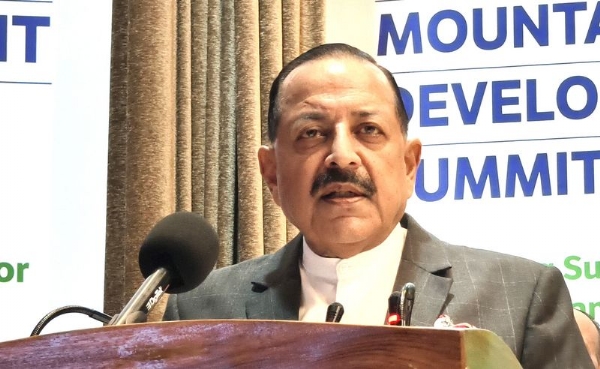
Jammu, 14 October (H.S.): Preserving the Himalayas and the Himalayan ecosystem is a national responsibility because every citizen has a stake in protecting this vital natural resource, Union Minister of State (Independent Charge) for Science and Technology and Earth Sciences, Dr. Jitendra Singh, said on Tuesday. He emphasised that the responsibility for safeguarding the Himalayan region extends beyond the government and scientific community to every citizen.
The special session, held at the Shalimar Convention Centre of Sher-e-Kashmir University of Agricultural Sciences and Technology of Kashmir (SKUAST-K), was part of the 13th All India Sustainable Mountain Development Summit, being held from October 12 to 14 under the theme “Contouring Sustainable Himalayan Landscapes for Inclusive Viksit Bharat”. The summit is jointly organised by SKUAST-K and the Integrated Mountain Initiative (IMI), with deliberations centred on sustainable mountain development and the draft Jammu & Kashmir Sustainable Mountain Development Policy 2026.
Those present included Secretary, Science and Technology, Babila Rakwal, Vice-Chancellor of SKUAST-K Prof. Nazir A. Ganai, and representatives of academia and the mountain development community.
Addressing the special session, the Minister said Himalayas are crucial to the country’s ecological security and support springs, water bodies, river sources and glaciers. The region also sustains tourism, agriculture and livelihoods, making its protection essential for both environmental security and inclusive economic development.
Dr. Jitendra Singh said the challenge is to balance development requirements and livelihood opportunities with the need to preserve a fragile mountain ecosystem. Unauthorised construction, unregulated activities and other human-made lap can aggravate risks in sensitive mountain regions. Ecological safeguards, therefore, must remain integral to development planning, supported by responsible public conduct and greater awareness among local communities and other stakeholders.
The Minister referred to the Department of Science and Technology (DST) Ministry of Science & Technology work under the National Mission for Sustaining the Himalayan Ecosystem, part of the National Action Plan on Climate Change. DST has identified three centres at the University of Kashmir, Sikkim University and Tezpur University to strengthen research on climate change and the Himalayan ecosystem. Climate change research and institutional capacity-building are also being supported through state-level initiatives across the Indian Himalayan Region.
---------------
Hindusthan Samachar / Krishan Kumar

18 Aug 2026
ED raids KPSC office, 20 other locations over Karnatak veterinary recruitment scam
ED raids KPSC office, 20 other locations over Karnatak veterinary recruitment scam..