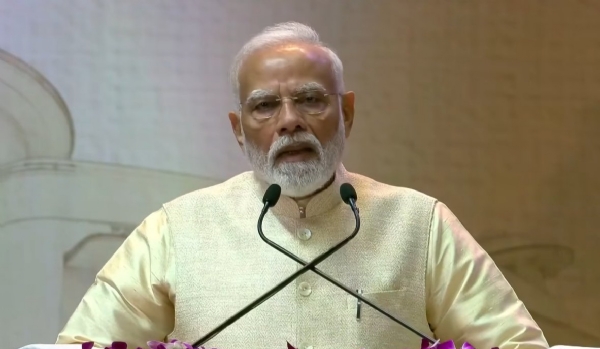
New Delhi, 14 October (H.S.): Prime Minister Narendra Modi has said that India’s governance model is no longer limited to providing welfare assistance but is increasingly becoming a means of empowering citizens and enabling them to participate actively in the country’s development. He highlighted initiatives related to sanitation, cooking gas connections, healthcare security and accessible credit as instruments for ensuring that benefits reach the last mile and creating new opportunities for people.
On Wednesday, the Prime Minister’s Office (PMO) shared an article written by Union Minister for Communications and Development of the North Eastern Region, Jyotiraditya Scindia, on the social media platform X. The PMO stated that the last-mile delivery of government schemes and greater public participation were bringing about meaningful changes in governance. This approach, it added, was an important foundation for achieving the goal of building a developed India, or Viksit Bharat, by 2047.
Jyotiraditya Scindia authored the article, titled “Moving Governance from Welfare to Empowerment”, in an English-language newspaper. In the article, he argued that governance under the Modi government had placed dignity, opportunity and public participation at its centre. He also referred to Mahatma Gandhi’s vision of giving a voice to the poorest person and Pandit Deendayal Upadhyaya’s philosophy of Antyodaya, which emphasises uplifting the last person in society.
According to Jyotiraditya Scindia, approximately Rs.50 lakh crore has been transferred directly into beneficiaries’ bank accounts through Direct Benefit Transfer (DBT) and the Jan Dhan–Mobile technology framework. The article also claimed that India’s economy had grown nearly threefold compared with 2013–14, reaching Rs.331 lakh crore. It further stated that more than 223,000 startups across the country had generated over 2.3 million jobs.
Jyotiraditya Scindia also highlighted the achievements of several flagship government schemes. He cited the provision of more than 105 million cooking gas connections under the Pradhan Mantri Ujjwala Yojana, the construction of approximately 120 million household toilets under the Swachh Bharat Mission and the provision of medical treatment to 120 million people under the Ayushman Bharat scheme.
Under the Pradhan Mantri MUDRA Yojana, more than 590 million collateral-free loans have been sanctioned, the article stated. It also noted that more than 30 million rural women associated with self-help groups had become “Lakhpati Didis”, a term used for women who achieve an annual household income of at least Rs.1 lakh through sustainable livelihood activities.
Jyotiraditya Scindia presented these initiatives as important steps towards enabling citizens to become more financially independent, expanding economic opportunities and transforming government welfare programmes into instruments of long-term empowerment.
---------------
Hindusthan Samachar / Jun Sarkar
18 Aug 2026