Rice to Be Delivered Directly to Army Supply Depots in Remote Areas of Ladakh and the Northeast
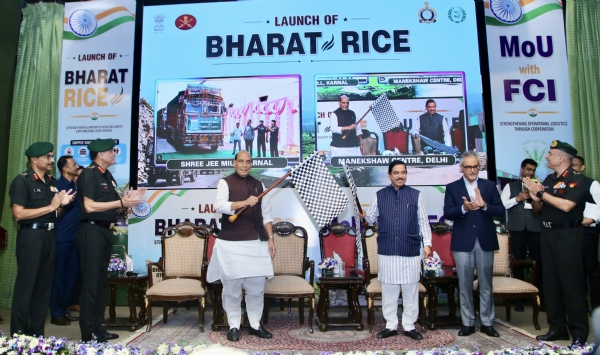
New Delhi, October 12 (HS): The Indian Army has introduced ‘Bharat Rice’ for soldiers deployed along the country’s borders, with supplies to be delivered directly to Army supply depots in remote areas of Ladakh and the Northeast.
To facilitate this initiative, the Indian Army and the Food Corporation of India (FCI) signed a Memorandum of Understanding (MoU) in New Delhi on Monday to utilise the FCI’s infrastructure during operational emergencies. Under the new arrangement, high-quality rice will be supplied directly to Army depots rather than being procured from local FCI warehouses.
Addressing the gathering, Defence Minister Rajnath Singh described ‘Bharat Rice’ as a bond of trust that begins in the farmer’s field and reaches the soldier’s plate. He said the initiative embodied the spirit of ‘Jai Jawan, Jai Kisan’ (Hail the Soldier, Hail the Farmer), as the hard work of farmers translates into strength for the nation’s soldiers.
The Defence Minister observed that although the initiative might appear modest, it would provide significant relief to personnel responsible for transporting essential rations to remote and inaccessible areas. He emphasised that the operational readiness of soldiers depended not only on their weapons but also on their physical health, mental stability, morale and endurance, particularly when serving under the most challenging conditions.
Rajnath Singh stressed that in modern warfare, weapons, equipment and technology were not the only decisive factors; logistics itself constituted combat power. Wars today are not won solely on the battlefield. The resilience of supply chains, storage capacity, transportation networks, warehousing infrastructure and the ability to ensure timely deliveries are equally critical to operational success, he said.
Referring to the strategic lessons of Operation Sindoor, the Defence Minister said the analysis of the operation indicated that warning times before future conflicts could be extremely short. Such circumstances, coupled with the growing integration of technology into warfare, could put the country’s preparedness to a severe test.
Singh said the MoU with the FCI represented an important step towards addressing these challenges. The corporation has an extensive nationwide network of warehouses, storage infrastructure, modern silos, material-handling equipment and trained personnel, including facilities in operationally important areas.
Drawing a parallel with other initiatives, he noted that fighter aircraft were now landing on expressways and that roads and bridges constructed by the Border Roads Organisation (BRO) were also being used by local residents. Similarly, FCI warehouses would no longer be confined to food storage but would become an integral part of the Indian Army’s supply chain, he said.
Chief of the Army Staff General Dhiraj Seth, Secretary of the Department of Food and Public Distribution Sanjeev Chopra, and senior officials from the Ministry of Defence, the Ministry of Consumer Affairs, Food and Public Distribution, the FCI, the National Agricultural Cooperative Marketing Federation of India Ltd. (NAFED) and the cooperative sector were present on the occasion.
---------------
Hindusthan Samachar / Jun Sarkar

18 Aug 2026