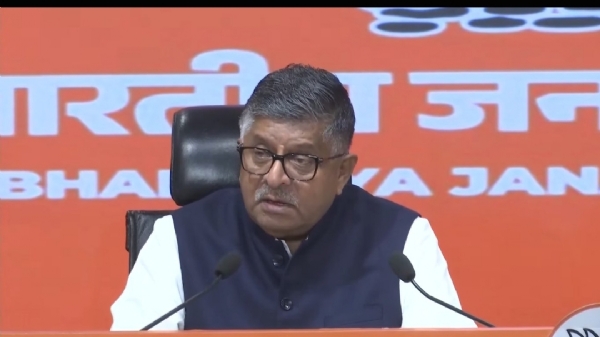
New Delhi, 10 October (H.S.): Senior Bharatiya Janata Party (BJP) leader and Member of Parliament Ravi Shankar Prasad launched a scathing attack on the Opposition on Saturday, asserting that the country would be governed through Parliament, democratic institutions and accountability, rather than through disorder on the streets. He said the protests witnessed in Delhi over the past three to four days indicated that the Opposition was attempting to use street demonstrations as a political weapon following its electoral setbacks.
Ravi Shankar Prasad clarified that the BJP was not opposed to the democratic right to protest, but stressed that demonstrations should not be used as a political instrument to create disorder or undermine democratic processes.
Addressing a press conference on Saturday, Ravi Shankar Prasad said the BJP’s victories in Assam, Nandigram and the National Democratic Alliance’s (NDA) success in Puducherry had raised questions about the Opposition’s political strategy. He claimed that the BJP had secured a victory by a margin of more than 70,000 votes in a constituency where over 70 per cent of the electorate belonged to minority communities. According to him, these results had come at a time when Opposition parties were attempting to shape the political narrative through demonstrations in Delhi.
Ravi Shankar Prasad said Rahul Gandhi had initially participated in the protests, followed by leaders of the Aam Aadmi Party (AAP) and other Opposition parties. West Bengal Chief Minister Mamata Banerjee and leaders of Left parties subsequently joined the demonstrations, he added.
Accusing the Opposition of using street protests to divert attention from its political failures, Prasad said voters had delivered their verdict through the democratic process and that political parties should respect the people’s decision.
Ravi Shankar Prasad also criticised the Opposition over its objections to electronic voting machines (EVMs) and the Special Intensive Revision (SIR) of electoral rolls.
He claimed that questions about EVMs began to be raised by Opposition parties after Narendra Modi became Prime Minister in 2014. According to Prasad, the Opposition accepts the credibility of EVMs when it wins elections but questions the same system when the BJP emerges victorious.
On the revision of electoral rolls, Ravi Shankar Prasad said the Special Intensive Revision process had been conducted more than nine times in the country and was provided for under the law.
He argued that the names of deceased individuals should not remain on electoral rolls, the records of people who had permanently shifted to other constituencies should be verified, and no individual should be registered as a voter at more than one location.
He also questioned whether individuals who were not Indian citizens should be included on electoral rolls, reiterating the need for accurate and legally compliant voter registration.
The BJP leader also accused Rahul Gandhi of failing to show due respect for constitutional institutions. Referring to a statement made by the Leader of the Opposition following a meeting with the President, Prasad said the remarks had attracted scrutiny. He further claimed that the President’s Office had disputed the accuracy of Gandhi’s account.
Emphasising India’s democratic sovereignty, Ravi Shankar Prasad asserted that the country was not a “banana republic”. He said that under Prime Minister Narendra Modi’s leadership, India had neither bowed down nor would it ever do so.
Decisions, he maintained, would be taken in the national interest, and arbitrary interference would not be tolerated, regardless of whether it came from foreign or domestic actors.
Ravishankar Prasad urged Rahul Gandhi to reflect on the Congress party’s historical record before raising the issue of the Emergency.
He referred to the Emergency imposed during the tenure of former Prime Minister Indira Gandhi, saying the country was well aware of that period in its political history. According to Prasad, the Emergency had been imposed to protect the government’s political position, and Left parties had also supported it.
He said BJP leaders and party workers had fought against the Emergency and argued that Gandhi should familiarise himself with that historical episode before lecturing others on the subject.
Ravi Shankar Prasad concluded by reiterating that democratic institutions and parliamentary processes must remain central to the functioning of the country, maintaining that electoral outcomes should be respected and political disagreements addressed within the framework of democracy.
---------------
Hindusthan Samachar / Jun Sarkar
18 Aug 2026