




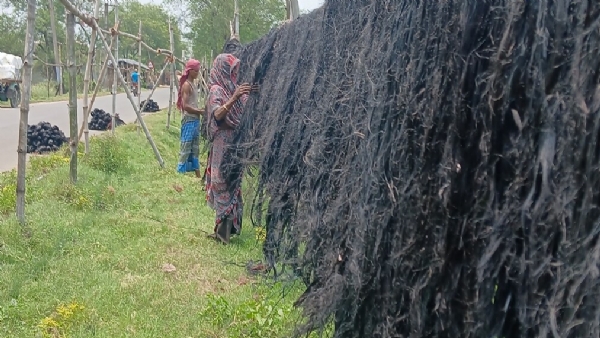
Howrah, 10 October (HS): In Parbatipur village of Howrah, religious differences take a back seat to craftsmanship and humanity. As Durga Puja approaches, Hindu and Muslim families work together to prepare wigs for idols of Goddess Durga and other deities. While some colour jute fibres, others carefully comb and arrange them into elaborate wigs. The faith may belong to the Hindus, but the skill and labour are shared by both communities. This decades-old tradition has not only taken Parbatipur's products to Kumartuli in Kolkata and other parts of the country but has also established the village as a remarkable example of communal harmony.
Located in the Jagatballavpur block of rural Howrah, Parbatipur witnesses a surge in activity as Durga Puja draws near. Men and women from both communities work side by side, often late into the night, to meet the growing demand. From Hindu households to the adjoining Muslim neighbourhood, artisans remain occupied with the painstaking process, leaving themselves little time to rest.
For decades, wigs made in the village have supplied idol-makers in Kumartuli, Kolkata's renowned hub of traditional clay idol-making. Orders also arrive from Bihar, Delhi, Uttar Pradesh and several other parts of the country. The products are even exported to neighbouring Bangladesh and Nepal, giving the village's traditional craft an international reach.
Wigs Crafted from Jute Fibres
According to local artisans, black wigs are made for Goddess Parvati, while red ones are prepared for Lord Shiva. Orange wigs are also sometimes required for other idols. The styles vary, with some wigs featuring straight hair and others having curls.
The process begins with raw jute procured from Mashat and Shiakhala in Hooghly district. The fibres are washed, boiled, dried in the sun and then dyed. Once the colour has dried, the fibres are cut to the required length and arranged with the help of special combs fitted with nails. To create curls, the fibres are wrapped around thin jute sticks and left for a considerable period.
After the excess fibres are removed, the finished hair is packed and sent to shops, from where it reaches idol-makers. The artisans' painstaking work eventually becomes part of the elaborate appearance of the deities, giving the idols their distinctive look.
A Living Example of Communal Harmony
The Upanishadic expression “Amritasya Putrah” means “children of immortality”, conveying the idea that all human beings share a common spiritual heritage.
In Parbatipur, this spirit finds expression in the everyday lives of Hindu and Muslim artisans who work together to create the wigs adorning idols of Hindu deities. Their shared craftsmanship demonstrates how mutual cooperation and a common livelihood can transcend religious boundaries.
This enduring tradition is not merely a source of livelihood for the village but also a powerful example of communal harmony and social unity, reflecting the inclusive spirit of Bengal and India.
---------------
Hindusthan Samachar / Santosh Madhup