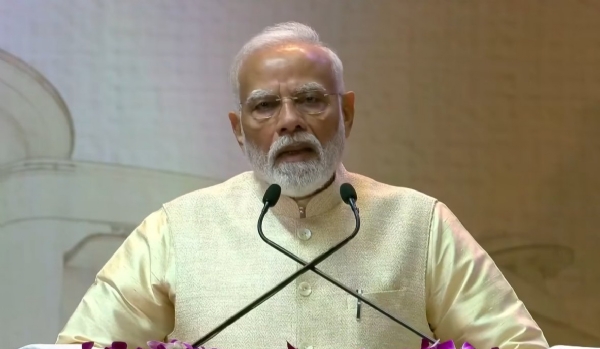
New Delhi, 01 October (H.S.): Prime Minister Narendra Modi on Thursday stressed the need to align the Union Public Service Commission’s (UPSC) selection process with the requirements of the future, saying recruitment examinations should assess not only a candidate’s knowledge but also the reasons behind their decision to join the civil services. He said “Nation First” and “Citizen First” should remain the key benchmarks for selection in the endeavour to build a developed India.
Addressing the centenary celebrations of the UPSC at Bharat Mandapam, Modi said India in 2047 would be significantly different from the India of today. The country would be more urban, the gap between villages and cities would narrow, and the aspirations and expectations of its young population would be substantially higher. Public services, he said, would therefore have to match the pace of today’s instant-service environment.
The Prime Minister said that when artificial intelligence can process thousands of documents within moments and governments have access to real-time data, citizens naturally expect faster solutions. The criteria for selection and the recruitment process must therefore evolve in line with future requirements. He stressed the need to bring into public service young people who are motivated by public service rather than by government office.
PM Modi said the guiding principle of India’s 21st-century work culture should be “Pro-People, Proactive, Good Governance”. The government, he said, should place citizens’ interests at the centre of its functioning and anticipate problems rather than wait for them to emerge before working on solutions. Referring to the principle of “Nagrik Devo Bhava”, he said serving citizens must remain the highest priority.
The Prime Minister said civil servants in the age of artificial intelligence would face new and complex challenges, including information warfare, deepfakes, algorithmic bias and climate justice. The selection process, therefore, should give greater importance to candidates’ ability to solve complex problems and demonstrate foresight.
PM Modi also emphasised the need to reduce the time taken by the examination process. An examination, he said, should not be treated merely as an event because it is directly connected with the future and lives of young aspirants. Delays of several months can increase expenses related to coaching, accommodation and transportation, thereby placing an additional burden on families.
He called for the examination system to adopt the principle of “time certainty” and shorten the examination cycle without compromising standards. Modi said the UPSC had already reduced the duration of its examination cycle by around 100 days.
The Prime Minister also called for stronger coordination between the UPSC and State Public Service Commissions and greater sharing of best practices. He suggested making national conferences more productive, studying effective international practices and using technology to improve procedural efficiency. He also emphasised the need to standardise processes and benchmarks and strengthen the capacity of the commissions.
PM Modi said that when the UPSC was established, young people from major cities, privileged families and leading educational institutions had greater access to opportunities. Today, however, candidates from villages and smaller towns are increasingly entering public service. He noted that women’s participation had also risen steadily, from around 3 per cent among civil services candidates in 1952 to more than 30 per cent today.
He said the number of candidates appearing for UPSC examinations had increased more than 45-fold compared with the period when the Commission completed 50 years in 1976. Selecting the right candidates from such a large pool of talent, he said, represents a major responsibility for the commissions, as selected officers eventually serve as representatives of the government at the grassroots level.
The Prime Minister said the UPSC had strengthened its credibility during its first century and would now have to build further on that foundation while responding to new opportunities and challenges in its second century. Independence, impartiality, merit, confidentiality and fairness in the selection process, he said, are central to the UPSC’s identity and must always be preserved.
Earlier, PM Modi visited an exhibition documenting the UPSC’s 100-year journey and released a commemorative coin, postage stamp and a book based on “100 Important Judicial Decisions”. The UPSC was established on October 1, 1926.
During the ceremony, the Prime Minister also praised the courage and presence of mind displayed by Indian Captain Smit during a recent mid-air incident. He said the captain’s bravery had made every Indian proud and appealed to people across the country to pray for his good health and long life.
---------------
Hindusthan Samachar / Jun Sarkar
18 Aug 2026