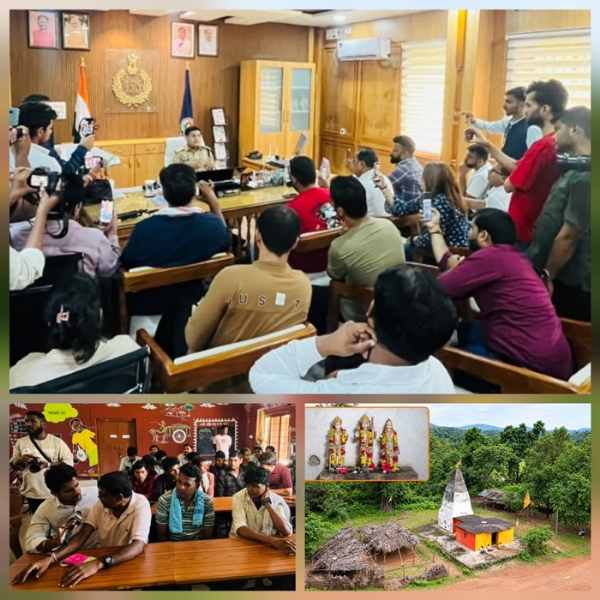
Jagdalpur, 01 October (H.S.): On the second day of their visit to Bastar in Chhattisgarh, 43 influencers from Delhi travelled from Sukma to Jagargunda via Kerlapenda and onward to Puvarti on Thursday. During a journey lasting more than 13 hours, they witnessed first-hand the changing face of Bastar, a region that for decades was largely known to the country through reports of Naxal violence.
The influencers interacted with former Naxals who have returned to the mainstream at a rehabilitation centre, learned about the security arrangements in the region, travelled along Jagargunda’s ‘Killer Road’ and visited an area associated with the killing of 76 security personnel. Their journey also included interactions with villagers, a visit to the Shri Ram temple that remained closed for 21 years, and, finally, a meeting with members of Naxal commander Hidma’s family in Puvarti. The entire journey offered a vivid picture of Bastar’s past, present and changing circumstances.
After reaching Sukma, the influencers first visited the Sukma rehabilitation centre. There, they directly interacted with former Naxals who had surrendered, abandoned the path of violence and returned to mainstream society. During the interaction, they sought to understand their lives, the changes they experienced after surrendering and their journey towards returning to a normal life.
The influencers then met the Superintendent of Police in Sukma. They were briefed on efforts to strengthen security, peace, development and administrative outreach in the region. They also sought to understand how civilian facilities and development initiatives are gradually reaching remote areas of Bastar that were once considered difficult to access, alongside improved security arrangements.
While in Sukma, the group also visited the Science Park. In contrast to the region’s long-standing image of forests and conflict, the visit offered a glimpse of another side of Bastar, where education, science and modern facilities are also finding space.
The journey then continued towards Tongpal, after which the group proceeded to Jagargunda. One of the most significant parts of the journey was the route that was once locally known as the ‘Killer Road’.
As they travelled along the route, the influencers learned about the period when the area remained a major centre of Naxal violence and security challenges for an extended period. After reaching Jagargunda, they were briefed about the area’s association with the memory of the Tadmetla attack of 2010, in which 76 security personnel were killed. The attack took place on April 6, 2010, and claimed the lives of 76 CRPF personnel.
For the influencers, this stop was more than an opportunity to learn about history. Standing at places whose names once regularly appeared in national headlines in connection with violence gave them an opportunity to understand Bastar and its past from a different perspective.
Moving ahead from Jagargunda, the influencers reached Kerlapenda, where they encountered one of the most poignant symbols of Bastar’s changing landscape — the Shri Ram temple. The temple had remained closed for nearly 21 years because of fear and insecurity. Marble idols of Lord Ram, Mata Sita and Lord Lakshman are installed inside the temple.
During the period of Maoist influence in 2003, villagers were reportedly ordered to keep the temple closed and refrain from conducting worship there. The atmosphere of fear was such that people avoided even going near the temple. Worship remained suspended there for nearly 21 years.
The situation changed in April 2024. With the presence of security forces and cooperation from villagers, the temple was cleaned and its doors were reopened after being shut for nearly 21 years. The temple, whose doors had once been closed because of fear, once again began to echo with the sound of bells and prayers.
The Kerlapenda episode is significant because the village was once known as an area under Maoist influence. Following the surrender of 16 Maoists in 2025, including nine from Kerlapenda, the village was declared Maoist-free.
The group then set out for Puvarti. After several hours of travelling through forests and remote areas, the influencers reached Puvarti at night. Puvarti is the ancestral village of Naxal commander Hidma.
There, the influencers interacted with Hidma’s elder brother, sister-in-law and nephew. They spoke to the family about the village’s present circumstances, local life and the changes that have taken place in the area. The meeting was the most sensitive part of the entire journey.
On one hand, Hidma’s name has long been associated with Naxal violence in the country. On the other, sitting face-to-face with members of his family in his ancestral village and speaking to them offered the influencers a different perspective on Bastar’s complex social realities.
The significance of Bastar’s story lies in understanding what has changed in the region today and how it is emerging from its troubled past. In areas once identified primarily with fear and conflict, new channels of dialogue are emerging, interaction between villagers and security forces is increasing, development activities are reaching remote areas, and examples of normalcy returning to people’s lives are becoming visible.
---------------
Hindusthan Samachar / Jun Sarkar

18 Aug 2026