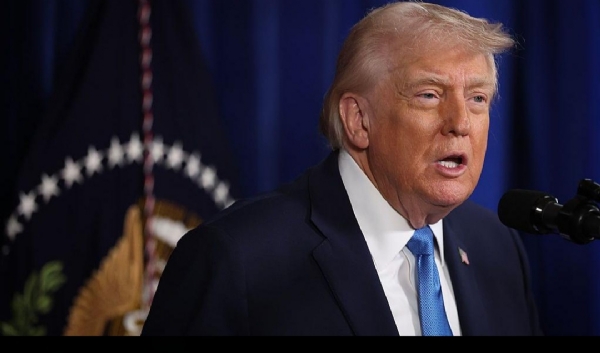
Washington , 08 January (H.S.): President Donald Trump proposed on Wednesday, a staggering $1.5 trillion military budget for fiscal year 2027—nearly double the current $901 billion allocation—framing the escalation as imperative for forging a Dream Military to safeguard America in troubled and dangerous times.
The announcement via Truth Social follows the January 3 U.S. special forces raid capturing Venezuelan President Nicolás Maduro on drug trafficking indictments, with naval assets still amassed in the Caribbean enforcing oil sanctions.
Trump justified the windfall through tariff revenues amassed since his January 2025 inauguration, positioning it as fiscal ballast for primacy against peer competitors.
Strategic Imperatives and Regional Posturing
This audacious blueprint arrives amid Trump's Greenland gambit—envisioned as an Arctic bastion against Russian naval expansion and Chinese mineral quests—and veiled threats of Colombian intervention, complementing Secretary of State Marco Rubio's portentous declaration that Cuba faces peril.
U.S. forces' interdiction of the Russian-flagged Marinera tanker in the North Atlantic on January 7 underscores maritime enforcement vigor, while domestic housing edicts and 50 percent India tariffs signal holistic America First realignment.
The proposal eclipses prior highs, surpassing the $858 billion peak under Biden, to fund hypersonic arsenals, AI-driven battle networks, and Pacific deterrence.
Fiscal Underpinnings and Congressional Path
Trump attributes funding buoyancy to protectionist duties on allies and adversaries alike, insulating the Pentagon from sequestration risks that hobbled predecessors. Yet realization hinges on a divided Congress wary of deficits ballooning past $36 trillion, even as hawks tout readiness against hypersonic asymmetries with Moscow and Beijing.
The 2026 outlay, locked at $901 billion, already prioritizes 6th-generation fighters and Columbia-class submarines; 2027's quantum leap portends procurement of directed-energy weapons and space domain assets.
Global Reverberations
Allies brace for transatlantic friction as NATO partners grapple with equity pleas, while Indo-Pacific partners like India—navigating Jaishankar's European pivot—assess implications for Quad interoperability. Beijing and Moscow decry hegemonism, accelerating A2/AD lattices from the Spratlys to Kaliningrad.
Trump's Davos disquisition in two weeks will elucidate synergies with housing affordability thrusts and Venezuelan reconstruction mandates, cementing a worldview where military preeminence underwrites economic sovereignty.
---------------
Hindusthan Samachar / Jun Sarkar

09 Jan 2026