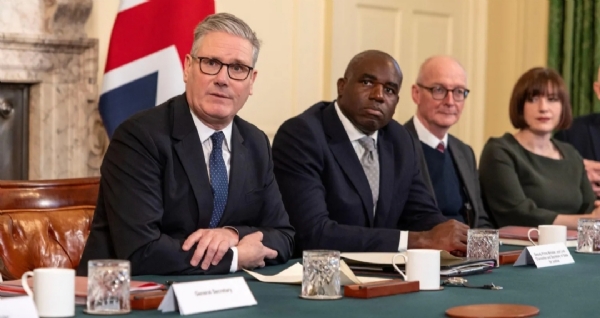
London, 07 January (H.S.): Prime Minister Sir Keir Starmer has launched a bold new campaign for 2026, urging his cabinet to confront the cost of living crisis head-on and sharply contrasting Labour’s vision with what he described as the “divisive” politics of Reform UK.
In his first cabinet meeting of the year, held at Downing Street on January 6, Starmer called for “relentless focus” on delivering tangible improvements to public services and easing the financial burden on households, as Labour faces mounting pressure ahead of crucial elections in May.
Starmer’s remarks came amid a dramatic shift in the political landscape. Recent polling by More in Common and YouGov reveals Reform UK leading with 26% support, while Labour trails at 17%, marking a significant decline since the party’s landslide victory in 2024�.
The prime minister acknowledged the challenge, stating, “The choice is between a Labour government renewing the country or a Reform movement that feeds on grievance, decline, and division.” He accused Reform UK of seeking to “inject bile into our communities” and warned of their approach to weakening the state and appeasing foreign adversaries.
Cost of Living at the Forefront
Starmer reiterated that tackling the cost of living would remain the government’s central priority. He highlighted several measures, including the £350 Cost of Living Payment being distributed in January, a freeze on rail fares, increases to the National Living Wage, and reductions in interest rates that are lowering mortgage costs.
The government is also expanding the Warm Home Discount, offering an additional £150 to 2 million more low-income households, and uprating benefits in line with inflation to help millions cope with persistently high bills.
Despite these efforts, critics argue that Labour’s progress has been slow and uninspiring. Conservative leader Kemi Badenoch accused Starmer of leading a “weak government” with “no plan, no agenda,” asserting that economic growth remains stagnant and household bills continue to rise.
Speculation is rife in Westminster that Starmer could face a leadership challenge if Labour performs poorly in the upcoming council and devolved elections.
Labour’s Renewal vs. Reform’s Division
Starmer’s renewed emphasis on renewal and unity comes at a time of profound uncertainty. He stressed that “governments do not lose because polls go down. They lose when they lose belief or nerve. We will do neither.” He called on ministers to demonstrate “hard work, focus, and determination,” urging them to avoid the “politics of quick fixes and gimmicks” and instead deliver real change that people can feel.
As Starmer prepares to join world leaders in Paris to discuss Ukraine’s future, his domestic reset is being closely watched. With Labour’s popularity at its lowest ebb since taking office and Reform UK’s momentum building, 2026 could well define the trajectory of both parties—and the future of British politics.
Hindusthan Samachar / Jun Sarkar

08 Jan 2026