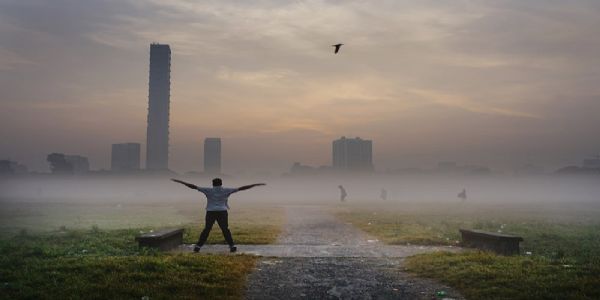
Kolkata, 07 January (H.S.) : A sharp fall in temperatures has blanketed Kolkata in dense fog, aggravating air pollution and intensifying health concerns across the city. The combined effect of cold weather and persistent fog has pushed air quality to hazardous levels, with elderly residents and children reporting increased breathing difficulties. Asthma patients, in particular, are facing more severe complications.
According to officials, conditions began deteriorating from New Year’s night itself, when fireworks added toxic fumes to the atmosphere. Since then, temperatures have continued to drop, allowing fog to settle over the city. During winter, heavier air coupled with fog traps fine and ultra-fine particulate matter near the ground. As a result, Kolkata has remained under a haze not only during early mornings but well into the afternoon over the past few days.
The impact is most visible in pollution hotspot areas. On Wednesday, levels of ultra-fine particulate matter PM 2.5 crossed 300 micrograms per cubic metre in several parts of Kolkata and Howrah. Environmental groups have also raised concerns over the burning of wood and plastic during winter fires, which further contaminates the air.
Experts say stagnant winter air is driving the city’s average Air Quality Index rapidly towards the “poor” and “very poor” categories. In recent days, the AQI in Jadavpur ranged between 275 and 305. The Rabindra Bharati University area recorded readings as high as 316 for several consecutive days, posing serious public health risks. Ballygunge also reported AQI levels hovering between 275 and above 300, while Salt Lake saw fluctuations from 180 to 278. Specialists attribute this deterioration largely to winter smoke, fog and lack of air movement.
Meteorologists explained that during winter, the lower layers of the atmosphere remain stable, preventing pollutants such as PM 2.5 and PM 10 from dispersing upward. When temperatures fall below 13 degrees Celsius, dense fog forms and holds these pollutants in place for longer periods, worsening air quality.
Low temperatures, fog, vehicular emissions and increased fuel burning during winter are being cited as the primary contributors to pollution. Cold weather also causes vehicle engines to emit relatively higher exhaust, which fails to disperse in stagnant air. This has a direct impact on public health, increasing the risk of asthma, bronchitis and heart-related ailments among vulnerable groups.
The Kolkata Municipal Corporation has begun spraying water in highly polluted areas to reduce dust particles, but the impact has been limited. Environmentalists argue that without strict action against open burning, conditions are unlikely to improve. Data shows that PM 2.5 levels peaked at 309 in Jadavpur, reached 331 in the Rabindra Bharati University area, stood at 296 near Victoria Memorial, and soared to around 395 in Howrah’s Ghusuri area, triggering widespread concern.
Hindusthan Samachar / Satya Prakash Singh

08 Jan 2026