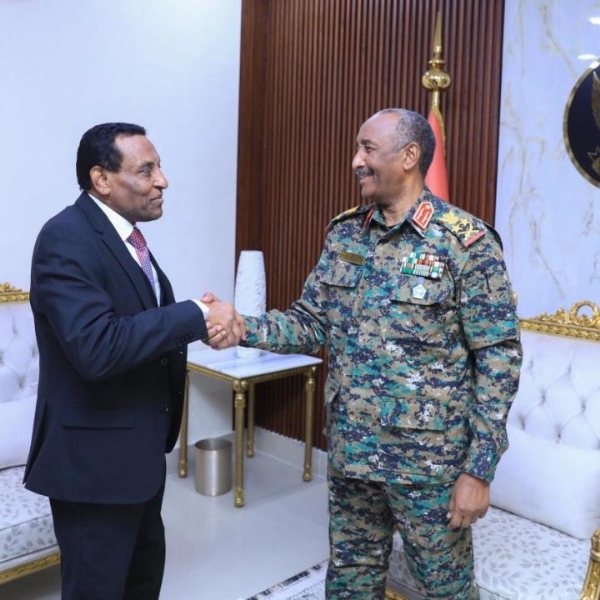
Khartoum, Sudan, 12 January (H.S.): Sudan's military-backed administration marked a symbolic milestone on Sunday, by formally returning to the war-ravaged capital of Khartoum, ending nearly three years of operations from the eastern wartime base of Port Sudan.
Prime Minister Kamil Idris, addressing reporters amid the ruins of the presidential palace, proclaimed the arrival of the government of hope, pledging immediate restoration of essential services for a population scarred by displacement and devastation.
Conflict's Brutal Legacy and Recent Military Gains
The civil war erupted on April 15, 2023, pitting the Sudanese Armed Forces (SAF), led by General Abdel Fattah al-Burhan, against the paramilitary Rapid Support Forces (RSF) under General Mohamed Hamdan Dagalo (Hemedti), forcing the government to flee as RSF fighters seized key sites including the airport and ministries.
A pivotal SAF offensive in March 2025 recaptured most of Khartoum, including the presidential palace on March 20, after intense urban combat that left vast swathes in ruins, with UN estimates citing over 150,000 deaths nationwide and 12 million displaced—the world's gravest humanitarian crisis.
Residents endured RSF occupation marked by mass looting, home occupations, and atrocities, while basic services like electricity and water remain barely functional, as noted by UN official Ugochi Daniels in October 2025.
Reconstruction Priorities and Bold 2026 Vision
Idris outlined urgent priorities during his Sunday address: rehabilitating healthcare facilities, reopening schools, and restoring electricity, water, sanitation, and education infrastructure, with an estimated $350 million needed for essentials per UN assessments.
He declared 2026 the year of peace, signaling optimism despite ongoing RSF drone strikes and skirmishes, particularly around el-Fasher, which fell to RSF control on October 26, 2025, after an 18-month siege prompting over 100,000 further displacements.
Approximately 1.2 million residents have trickled back since March 2025, contending with unmarked graves, collapsed buildings, and five million who fled at the conflict's peak.
International Dimensions and Stalled Peace Efforts
Both factions face credible accusations of war crimes, including ethnically targeted massacres, with the UAE under scrutiny for alleged RSF arms support—claims it denies—while external backers fuel the proxy conflict.
Failed mediation by the US, Saudi Arabia, and African Union has yielded no ceasefire, as foreign weapons inflows prolong the power struggle rooted in the 2021 coup fallout. Idris, a former UN official who dissolved the caretaker government in June 2025 to form his technocratic cabinet, faces criticism as an SAF proxy, yet the return underscores gradual federal reinstitution via a national committee decreed by al-Burhan last July.
---------------
Hindusthan Samachar / Jun Sarkar
12 Jan 2026
Trump Signals Imminent Military Reckoning: Iran Crosses All Limits with Protest Bloodshed

12 Jan 2026
Trump Issues Ultimatum to Cuba: Make a Deal Before It's Too Late Amid Venezuelan Oil Crackdown
12 Jan 2026