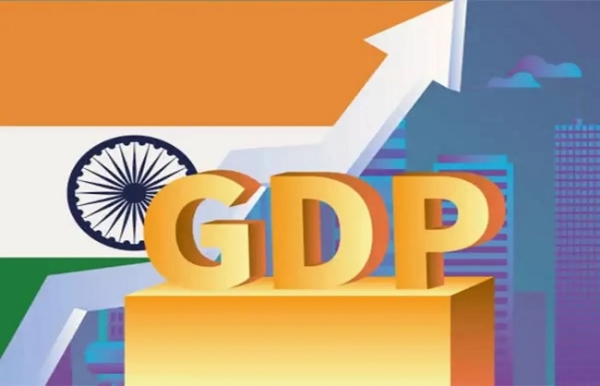
Mumbai, 5 December (H.S.): The Reserve Bank of India (RBI) has revised its GDP growth forecast for the ongoing financial year 2025–26 upward to 7.3%, from the earlier estimate of 6.8%, citing robust economic expansion of 8.2% recorded during the July–September quarter.RBI Governor Sanjay Malhotra announced the decision at the conclusion of the three-day Monetary Policy Committee (MPC) meeting held from December 3 to 5, highlighting that the revision followed a detailed assessment of India’s evolving macroeconomic conditions and medium-term growth outlook.
Governor Malhotra stated that strong private consumption and continued gains from Goods and Services Tax (GST) reforms have boosted second-quarter growth. “In view of the resilient domestic demand, the GDP growth projection for FY2025–26 has been raised to 7.3%, nearly half a percentage point higher than the previous estimate,” he said.
Growth and Policy Outlook
The RBI expects GDP growth to moderate slightly in the coming quarters, projecting expansion of 7.0% in the third quarter and 6.5% in the fourth quarter of FY2025–26. For FY2026–27, GDP growth is forecast at 6.7% for the first quarter and 6.8% for the second quarter.
Highlighting the steady pace of domestic activity and a sustained rural recovery, Governor Malhotra said urban demand is also witnessing consistent improvement. Taking these trends into consideration, the central bank has unanimously decided to cut the policy repo rate by 25 basis points, lowering it from 5.5% to 5.25%.
Inflation and Growth Balance
The rate cut follows a period of robust economic performance supported by solid GDP growth and cooling inflation. India’s retail inflation rate eased sharply to 0.25% in October 2025, marking its lowest level on record. This combination of stable prices and strong growth provided room for the RBI to adopt a calibrated, growth-supportive stance.
With the latest policy adjustment, the central bank aims to balance the goal of sustaining economic momentum while ensuring price stability and healthy financial conditions across markets.
---------------
Hindusthan Samachar / Jun Sarkar