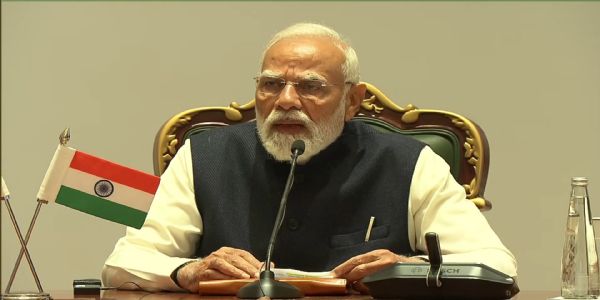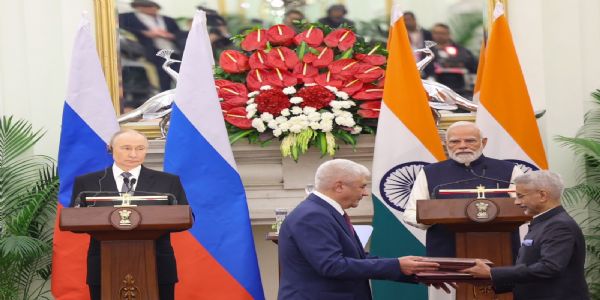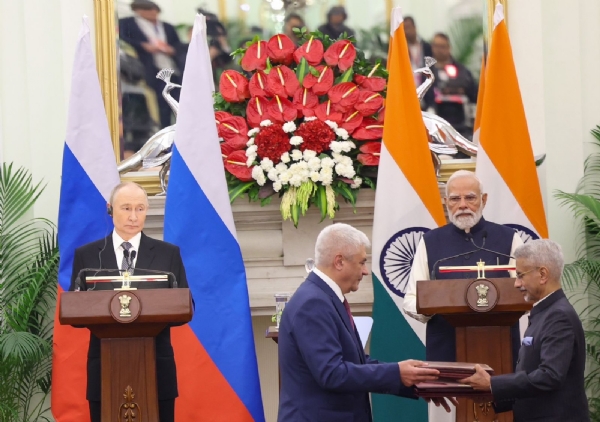
New Delhi, 5 December (H.S.): India and Russia on Friday reaffirmed their Special and Privileged Strategic Partnership as Prime Minister Narendra Modi and Russian President Vladimir Putin met in New Delhi for the 23rd India–Russia Annual Summit. The two leaders reiterated their commitment to expand cooperation across multiple sectors — defence, energy, trade, technology, nuclear science, mobility, education, and space — underscoring that bilateral ties remain an enduring pillar of mutual trust and global stability.The summit carried special significance, marking 25 years of the India–Russia Strategic Partnership Declaration, first signed during President Putin’s visit to India in October 2000.
In a joint statement titled “India–Russia: A Time-Tested Progressive Partnership Anchored in Trust and Mutual Respect,” both sides emphasized that their collaboration remains resilient amid shifting international dynamics and continues to serve as a cornerstone for global peace, stability, and a multipolar world order.Strategic and Diplomatic EngagementsLeaders from both nations appreciated the growing intensity of bilateral engagement through high-level visits, intergovernmental commissions, and ministerial consultations.
The opening of two new Indian Consulates General in Yekaterinburg and Kazan was welcomed as a step toward enhancing trade, investment, and cultural ties.India and Russia also conducted several rounds of meetings between their Defence and Foreign Ministers, National Security Advisors, and business representatives. The joint commissions — the IRIGC-TEC and IRIGC-M&MTC — have expanded cooperation in trade, economics, science, defence production, and cultural exchange.
Economic and Trade Cooperation
The leaders reaffirmed their goal to raise bilateral trade to USD 100 billion by 2030, focusing on a balanced and sustainable partnership. The Programme for the Development of Strategic Areas of India–Russia Economic Cooperation till 2030 was adopted to guide economic priorities for the coming decade.
Both sides stressed the need to address tariff and non-tariff barriers, streamline logistics, and promote national currency settlements to ensure uninterrupted trade. Ongoing consultations will also explore interoperability between central bank digital currency systems and financial messaging networks.
Energy, Transport, and Connectivity
Energy cooperation was described as a central pillar of the partnership, spanning oil, gas, petrochemicals, nuclear energy, and new technologies such as underground coal gasification and LNG infrastructure development. The two sides agreed to resolve long-pending investment issues and protect investor concerns.
Transport and connectivity remain key priorities. The leaders committed to accelerating progress on the International North–South Transport Corridor (INSTC), Chennai–Vladivostok Maritime Corridor, and the Northern Sea Route.
An MoU was signed on training Indian specialists for ships operating in polar waters.Cooperation in the Far East and ArcticThe summit reaffirmed India’s growing interest in the Russian Far East and Arctic region, with both nations agreeing to intensify trade and investment collaboration in energy, mining, agriculture, and pharmaceuticals.
Russia appreciated India’s active participation in the 6th International Arctic Forum in Murmansk.Defence and Military CollaborationDescribed as a cornerstone of bilateral relations, the India–Russia defence partnership is now being refocused toward co-development and co-production under the “Make in India” initiative.
The 22nd Session of the IRIGC on Military and Military-Technical Cooperation, held in New Delhi on December 4, 2025, reaffirmed the joint commitment to advance joint research, transfer of technology, and indigenous manufacturing of spares and defence components.The two sides also expressed satisfaction with regular joint military exercises such as INDRA, and discussed enhancing interoperability and expanding exchange programmes among defence delegations.
Civil Nuclear and Space Cooperation
In nuclear energy, both countries confirmed plans to expand cooperation on the Kudankulam Nuclear Power Plant (KKNPP) and explore new sites for future reactors. India aims to raise its nuclear energy capacity to 100 GW by 2047, with Russia remaining a key partner in technology, fuel supply, and life-cycle support.
Space collaboration continues to grow between ISRO and Russia’s Roscosmos, covering satellite navigation, human spaceflight, and rocket engine manufacturing. Both sides reiterated support for peaceful use of outer space and new joint missions.
Science, Technology, and Education
India and Russia pledged to deepen collaboration in emerging technologies, including quantum computing, cybersecurity, artificial intelligence, and critical minerals. The Roadmap for Science, Technology, and Innovation Cooperation will continue to guide academic and industrial research partnerships.
Both sides expressed mutual interest in expanding student and institutional exchanges, academic mobility, and collaborative university-level research.
Cultural and People-to-People Exchange
Cultural engagement was reaffirmed as an essential element of the India–Russia partnership. Plans were announced for Cultural Exchange Festivals and an increased number of bilateral film, art, and literary collaborations. Both countries welcomed the introduction of a 30-day e-tourist visa and group tourist visa on a gratis basis for Russian nationals to boost tourism.
Global and Regional Issues
The leaders reaffirmed cooperation in UN, G20, BRICS, and the Shanghai Cooperation Organisation (SCO) platforms, emphasizing reform of the UN Security Council and greater representation of developing nations. Russia reiterated its strong support for India’s permanent membership in a reformed UNSC.Both nations condemned terrorism in all its forms and manifestations, specifically referencing attacks in Pahalgam (India, April 2025) and Crocus City Hall (Russia, March 2024). They called for stronger cooperation against cross-border terrorism and adoption of the UN’s Comprehensive Convention on International Terrorism.
Major Outcomes and MoUs Signed
A series of bilateral agreements and MoUs were finalized during the summit, covering key sectors:
Migration and Mobility: Employment and irregular migration agreements between India and Russia.
Health and Food Safety: Cooperation on medical research, education, and food safety standards.
Maritime Cooperation: MoUs on polar training and maritime logistics between transport ministries.
Fertilizers: Agreement between UralChem (Russia) and Indian firms RCF, NFL, and IPL for long-term supply and joint ventures.
Trade and Customs: Protocol on pre-arrival exchange of goods data and improved postal and customs connectivity.
Academic Collaboration: MoUs between DIAT Pune and Tomsk State University; University of Mumbai, Moscow State University, and RDIF.
Media and Broadcasting: Multiple MoUs with Russia’s national and private broadcasters, including Gazprom Media, National Media Group, Big Asia, TV Novosti, and TV BRICS, to enhance media exchange.
Cultural Cooperation: Agreement on the exhibition India: Fabric of Time” between India’s National Crafts Museum and Moscow’s Tsaritsyno Museum.
Environment and Wildlife: Russia’s decision to join the International Big Cat Alliance (IBCA) and participate in joint conservation efforts.
Closing Remarks
President Putin expressed gratitude to Prime Minister Modi for the warmth and hospitality extended to the Russian delegation and invited the Prime Minister to Russia in 2026 for the 24th Annual India–Russia Summit.Both leaders concluded that the India–Russia partnership remains a stabilizing force in global geopolitics, driven by shared values of trust, equality, and mutual respect.
---------------
Hindusthan Samachar / Jun Sarkar